HD6 Replacement Remote for Hampton Bay Hunter Ceiling Fan Remote Control
$16.00
Description
The UC7078T receiver system is one of the most widely used ceiling fan control platforms Hampton Bay and Hunter have ever produced. Fans built around this receiver have been installed in homes across North America for years, and the remote that came with most of them — the FAN-HD handheld in its various iterations — has a well-documented lifespan. Buttons stick. Housings crack. Batteries leak and corrode the contacts. Sometimes the remote simply disappears into a couch cushion or a junk drawer and never surfaces again. When any of that happens to a fan that’s otherwise working perfectly, the HD6 replacement remote is the purpose-built answer for the UC7078T / CHQ7078T / CHQ8BT7078T receiver family, and understanding what it does and doesn’t do before you order is what separates a five-minute fix from a frustrating return.
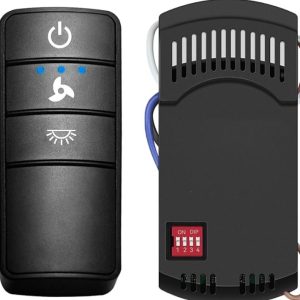
The first and most important thing to establish is what this product actually is. It is a handheld remote transmitter — nothing else. There is no receiver in the box, no wiring kit, no installation hardware beyond the wall mount bracket. If your existing receiver inside the fan’s canopy is functional, that’s ideal, because this remote is designed to pair directly with it and restore full control without any wiring work at all. If your receiver has also failed, this remote alone will not solve the problem and you’ll need a full kit that includes a replacement receiver. The distinction matters, and it’s worth checking your receiver before ordering rather than after.
Confirming Compatibility Before You Buy
This is not a universal remote. That point is made prominently in the product listing and it’s worth taking seriously. The HD6 operates at a specific frequency — 303.9MHz — and it is designed to communicate with receivers that were built to that specification. The way to confirm compatibility is straightforward: find your original remote and check the back for the FCC ID or model number. If it shows CHQ8BT7078T, CHQ7078T, UC7078T, L3H2003FANHD, L3H2010FANHD, L3HMAY97FANHD, FAN-HD, HD6, or RR7078TR, this replacement will work with your existing receiver. If the number on the back of your original remote doesn’t match any of those designations, this is the wrong product and you’ll need a different replacement.
The other compatibility point worth noting upfront is that this remote is designed for single light system fans only. If your fan has both an upper and a lower light — a dual light configuration where the two circuits are controlled independently — this remote cannot handle that setup. Fans with dual light systems need a different remote variant that includes separate up-light and down-light controls. If your original remote had two separate light buttons for upper and lower fixtures, this HD6 is not the right match regardless of the FCC ID on the back.
What the Remote Controls
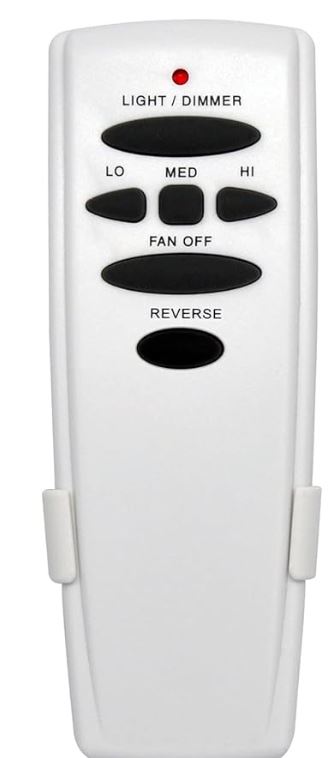
For the fans it’s compatible with, the HD6 covers the full range of functions that the original FAN-HD remote provided. Fan speed runs across three settings — high, medium, and low — plus a dedicated fan off button, which is a cleaner layout than remotes that require cycling through speeds to turn the fan off. The buttons are physically distinct and logically arranged, making operation intuitive even in the dark once you’re familiar with the layout.
The reverse function is one of the features that sets this remote apart from some competing replacements in the UC7078T space. Motor direction reversal is genuinely useful across both seasons — running the fan counterclockwise in summer pushes cooled air directly down into the room, while switching to clockwise in winter gently recirculates the warm air that collects near the ceiling without creating a wind chill effect on the people below. Having that function on the remote rather than requiring a ladder trip to flip a physical switch on the motor housing is a meaningful convenience, and the HD6 includes it as a standard button. One important caveat: the reverse function only works if your fan’s receiver was originally built to support motor reversal. The remote sends the signal, but the receiver has to be capable of acting on it. If your original remote had a reverse button, your receiver almost certainly supports it. If the original remote had no reverse button, the receiver likely doesn’t either, and the reverse button on this replacement will simply do nothing.
Light control handles on/off and dimming through a single button. Full dimming is available for incandescent and halogen bulbs and for dimmable LED and CFL lamps. If your light kit uses standard non-dimmable LED bulbs — which is increasingly common given how widely LED lighting has been adopted — the remote will control the light on and off but the dimming function won’t have any effect. This is a bulb-level limitation rather than a remote deficiency, and it applies universally across ceiling fan remote systems. If dimming matters to you and you’re currently running non-dimmable LEDs, swapping in dimmable LED bulbs is the solution.
Setup and Pairing
Getting the HD6 paired to your existing receiver takes a few minutes and requires no wiring at all. The remote uses four dip switches to establish its communication frequency with the receiver — the same dip switch system used by the original FAN-HD remotes. The switches are located inside the battery compartment, positioned behind the battery slot in a spot that’s easy to miss if you don’t know to look there. The process is to open your old remote, note or photograph the dip switch positions, then replicate that exact pattern on the new remote before installing the battery. Once the patterns match and the battery is in, the remote should pair and respond immediately without any additional steps.
If you no longer have the old remote to reference the switch positions, you’ll need to access the receiver inside the fan canopy to read the settings directly. That means cutting power at the breaker, removing the canopy cover, locating the receiver, and reading the switch positions there. It adds a step but it’s not complicated work. The 16 possible frequency combinations give you flexibility to change the channel if you’re experiencing interference from another remote or wireless device operating on a nearby frequency — though in practice, interference issues are uncommon in single-family homes where this system is most typically installed.
The battery requirement is a 9-volt — the rectangular type most commonly associated with smoke detectors. It’s not included in the box, which the listing notes. Having one on hand before you start saves the minor annoyance of discovering the omission mid-install. A 9-volt is available at any hardware, grocery, or convenience store, just not something most people have sitting in a drawer alongside AA and AAA cells.
Build Quality and Real-World Use
The HD6 is described across multiple listings as an OEM-equivalent product with FCC approval, and the build quality reflects that positioning. It’s not a premium device — the housing is straightforward plastic construction and the overall feel is consistent with what the original FAN-HD remote delivered — but it’s solid, the buttons have a satisfying tactile response, and nothing about the construction suggests it’s going to fail prematurely under normal household use. The wall mount bracket included in the package is a simple snap-in holder that mounts with two screws and keeps the remote accessible and in a consistent location, which goes a long way toward not losing it again.
Signal range performs well across a standard room. Unlike infrared remotes, the RF transmission doesn’t require line-of-sight with the fan, so the remote works equally well whether you’re pointing it at the ceiling, pressing it from under a blanket, or reaching for it on the nightstand without sitting up. The 303.9MHz frequency is reliable and the signal strength is consistent within normal residential room dimensions.
The Dual Light Limitation Worth Repeating
Because it’s the single most common compatibility mistake with this remote, it’s worth addressing a second time before wrapping up. The HD6 with reverse is built for fans with a single light circuit. If your Hampton Bay or Hunter fan originally shipped with a remote that had separate buttons for an upper and a lower light, this remote will not give you independent control of those two circuits. There is a variant of the UC7078T remote family designed specifically for dual-light configurations — it includes separate up-light and down-light control buttons — and that’s the version you’d need instead. Checking your original remote’s layout before ordering is the simplest way to confirm you’re getting the right version.
Who This Remote Is For
The HD6 replacement is the right product for anyone with a Hampton Bay or Hunter fan built on the UC7078T / CHQ7078T / CHQ8BT7078T receiver system who has a single light circuit on the fan and whose original remote included a reverse button. It replaces the original remote function-for-function, pairs to the existing receiver without any wiring, and does it at a fraction of the cost of replacing the full control system. For a fan that’s otherwise running well, it’s an efficient, low-effort fix that gets things back to normal quickly. Match your FCC ID, confirm your light configuration, grab a 9-volt battery, and the whole process from unboxing to working remote takes about ten minutes.