
Hampton Bay track lighting has become one of the most accessible and versatile lighting solutions available through Home Depot, offering homeowners a straightforward path to adjustable, directional illumination without the cost of hiring an electrician for a full custom system. Whether you are retrofitting a kitchen that needs better task lighting over the counters, adding accent lighting to a living room gallery wall, or replacing an outdated flush mount in a hallway, Hampton Bay track systems give you a practical combination of affordability and flexibility that few competing brands at the same price point can match. The lineup spans everything from basic two-light fixed bars to fully configurable H-track systems with multiple heads, and understanding how these products are organized, what accessories are compatible, and how installation actually works in practice will save you significant time, money, and frustration before you ever open a box.
How Hampton Bay Track Lighting Systems Are Organized
Hampton Bay sells track lighting under several structural formats, and getting this right before you purchase is critical because track heads, connectors, and extension bars are not always cross-compatible between formats. The most common format in the Hampton Bay lineup is the H-track system, also referred to as J-track in some documentation, which uses a three-conductor track with a specific head-mounting mechanism. This is the format you will encounter most frequently on Home Depot shelves and online, and it is also the format for which Hampton Bay sells the widest variety of replacement heads, flexible connectors, and straight extensions. A second format is the fixed two-head or three-head bar light, which is technically a track fixture but does not allow for repositioning of individual heads along a separate track section. These bar configurations are wired as a single unit and do not accept add-on components. Knowing which format you are buying matters enormously because purchasing a set of individual track heads and then discovering your bar fixture is not a true H-track system is one of the most common and avoidable purchasing mistakes in this category.
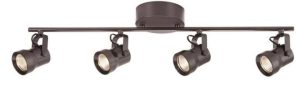
Within the H-track segment, Hampton Bay further divides products by finish and light source type. You will find fixtures in brushed nickel, oil-rubbed bronze, matte black, and white, and the finish of your track section should match the finish of your heads if you are mixing and matching components purchased separately. On the light source side, Hampton Bay has largely transitioned to LED across its track lighting lineup, though you will still encounter halogen fixtures in some clearance sections and third-party sellers. The LED versions are generally worth prioritizing not just for energy savings but because LED track heads run significantly cooler, which matters in kitchens and in rooms where the fixtures are operating for extended periods. The LED equivalents in the Hampton Bay lineup typically range from around 500 to 800 lumens per head depending on the model, which is appropriate for accent and task lighting but may require multiple heads in a large room if general ambient illumination is the goal.
Selecting the Right Track Length and Head Count for Your Space
One of the most practical decisions you will make when configuring a Hampton Bay track lighting setup is determining how long your track should be and how many heads you need to achieve the lighting effect you want. Hampton Bay sells track sections in lengths of two feet, four feet, and in some configurations up to eight feet, and you can extend runs further using straight connectors or flexible connectors that allow you to turn corners or create L-shaped and T-shaped configurations. As a general planning guideline, allow roughly one track head per 20 to 25 square feet of floor area when the track lighting is serving as the primary light source in the room. If it is supplementing other fixtures or serving purely as accent lighting over artwork or architectural features, you can space heads further apart and prioritize positioning over quantity.
Kitchen installations are where Hampton Bay track lighting tends to perform especially well and where getting the head count right has the most functional impact. Over a kitchen island or peninsula, a four-foot track section with three adjustable heads positioned to angle toward the work surface gives you good coverage without creating harsh overlapping hotspots. For a longer galley-style kitchen, an eight-foot run with four to five heads is typically more effective than two separate shorter sections, both because it reduces the number of electrical connections and because it gives you more flexibility in how you space the heads along the run. Living rooms with gallery walls or built-in shelving benefit from heads that can aim precisely at individual pieces or shelf sections, so in those applications even a two-foot track section with two heads can be the right answer if you are targeting a specific zone rather than lighting a broad area.
Hampton Bay Track Lighting Installation Step by Step
Installing Hampton Bay track lighting is a project well within reach for anyone comfortable working with basic electrical connections, but there are several steps where attention to detail prevents problems down the line. Start by turning off the circuit at the breaker, not just at the wall switch, before touching any wiring. Use a non-contact voltage tester at the outlet box to confirm the power is off before proceeding. Hampton Bay track systems mount to a standard electrical box, and the canopy cover that ships with the track kit is designed to conceal a four-inch or four-square box. If your existing electrical box is a two-inch octagon type, you may need a box extender or a replacement box before the canopy will sit flush against the ceiling, so check this before you get too deep into the installation.
Once you have verified the box is compatible and power is confirmed off, connect the track wiring to your ceiling wiring using the wire nuts included in the kit. Hampton Bay uses standard color coding with black to black for hot, white to white for neutral, and green or bare copper for ground. After making connections, fold the wires carefully back into the box and secure the mounting strap and canopy according to the instructions included with your specific model. The next step is attaching the track section itself to the ceiling. Hampton Bay tracks include a channel that clips onto the mounting hardware, and most systems also include toggle bolts or ceiling anchors for securing the track at points along its length away from the electrical box. These intermediate mounting points are important and often skipped by DIYers who assume the electrical box connection alone will hold the track rigid. In practice, a track section longer than two feet will sag or twist over time if not supported at additional points, which both looks poor and can create issues with the head connections.
After the track is secured, energize the live end connector by snapping it into the track channel according to the orientation marks printed on the connector body. Hampton Bay live end connectors have a specific insertion and rotation sequence, and inserting them incorrectly is one of the most common reasons a newly installed track system fails to power on. The connector needs to be fully seated and rotated until it locks, which you will feel as a firm click. Once the live end is in place, restore power and test the circuit before installing the heads. This lets you confirm the track is receiving power and identify any wiring issues before adding the complication of diagnosing multiple heads. Install the heads using the same insertion and rotation technique as the live end connector, position them to your target angles, and tighten the locking rings that hold each head at its set position.
Compatibility Between Hampton Bay Heads and Third-Party Tracks
A question that comes up frequently among people already working with installed track systems is whether Hampton Bay track heads can be used on tracks from other manufacturers, or conversely whether third-party heads will work on Hampton Bay tracks. The honest answer is that H-track is a nominally standardized format, but real-world compatibility is imperfect and depends on the specific manufacturer and production era of both components. Hampton Bay heads manufactured for H-track systems will generally fit and function on tracks from manufacturers like Juno, Halo, and Lightolier that also use true H-track dimensions, but there can be subtle variations in the conductor positioning or the width of the track channel that cause intermittent contact issues or prevent the locking mechanism from fully engaging. If you are working with an existing track from a different brand, the safest approach is to bring one of your existing heads or a connector to the store and test the fit in a Hampton Bay track section before purchasing a full set of new heads.
The reverse scenario, using third-party heads on a Hampton Bay track, comes up most often when homeowners want a specific style or finish that Hampton Bay does not offer. This is a reasonable approach and generally works with true H-track compatible heads, but the same caveat about conductor alignment applies. A loose or intermittent connection between a head and a track is not just a nuisance, it can cause arcing and create a fire risk over time, so if a head does not seat and lock cleanly with firm positive contact, it should not be used regardless of whether it seems to function initially. Hampton Bay also sells compatible heads through Home Depot that are explicitly labeled for H-track use, and sticking within this ecosystem when possible eliminates the compatibility guesswork entirely.
Troubleshooting Common Hampton Bay Track Lighting Problems
When a Hampton Bay track lighting system stops working or behaves unexpectedly, the failure is almost always in one of three places: the wiring connection at the ceiling box, the live end connector, or an individual head. Working through these systematically rather than immediately assuming the worst will resolve most issues without replacing parts. Start by restoring power and checking whether the entire track is dead or just specific heads. If the entire track has no power, turn off the breaker and check that the wire connections in the ceiling box are still secure, that the wire nuts are tight, and that neither the hot nor neutral wire has pulled free. This happens more often than you might expect, particularly in homes where the wiring has been disturbed by other nearby work or where the original connections were not made with sufficient wire overlap inside the nut.
If power is reaching the track but one or more heads are not illuminating, the most likely culprit is either a head that has not been properly seated and rotated into the locked position, or a head with a failed LED module. Remove the non-functioning head, inspect the contact points at the base for any debris or corrosion, and reinstall it with deliberate attention to the insertion and rotation sequence. If the head still does not function after proper reinstallation, move it to a different position on the track. If it works in the new position but not the original one, there may be a gap or damage in the conductor at that specific point on the track. If it fails to function in any position, the head itself has failed and should be replaced. Hampton Bay sells replacement heads separately, and the model number printed inside the canopy of your fixture will help you confirm compatibility when ordering a replacement.
Flickering is another common complaint with track lighting and usually indicates a loose connection somewhere in the system. If all heads flicker simultaneously, the issue is most likely at the live end connector or the ceiling box wiring. If one head flickers while others are stable, the connection between that specific head and the track is marginal, and reseating or replacing the head typically resolves it. Dimmer compatibility is worth checking if you have flickering on a dimmer-controlled circuit. Not all Hampton Bay LED track heads are rated for dimmer use, and even those that are compatible require a dimmer designed for LED loads. Using an incandescent-rated dimmer with LED fixtures is one of the most common causes of flickering and buzzing in track lighting installations, and replacing the dimmer with a current LED-compatible model from a brand like Lutron is often the complete fix.
Getting the Most from Hampton Bay Track Lighting Long-Term
Hampton Bay track lighting is designed to be a permanent but flexible installation, and the long-term value of the system comes from taking advantage of that flexibility as your needs change. The ability to reposition heads along the track without any tools beyond the locking ring adjustment means you can reconfigure your lighting anytime furniture moves, artwork changes, or you simply want a different distribution of light in the room. This is a meaningful practical advantage over recessed can layouts, which are fixed once installed. Periodically check that all heads are still seated securely in the track and that locking rings have not loosened over time, particularly if the fixtures are in a location with foot traffic vibration from an upper floor or in proximity to a frequently used door that creates pressure changes.
Keeping the fixture finishes in good condition is straightforward. Hampton Bay brushed nickel and matte black finishes can be wiped with a damp cloth, though you should avoid abrasive cleaners that will scratch the surface coating. For the acrylic or glass shades on some head styles, a glass cleaner applied to a cloth rather than sprayed directly onto the fixture is the appropriate approach. The LED modules in Hampton Bay track heads are not field-replaceable on most models, meaning when the LED array fails the entire head is replaced rather than just the bulb. Given the rated lifespan of the LED modules typically quoted at 25,000 hours or more, this is rarely a practical concern for several years of normal residential use, and the lower per-unit cost of Hampton Bay track heads compared to premium brands makes replacement financially reasonable when the time does come.