
Harbor Breeze is one of the most recognizable ceiling fan brands in North America, and for most people who’ve bought one, the purchase happened at Lowe’s — because that’s the only place you can buy them new. Harbor Breeze is a house brand sold exclusively through Lowe’s Home Improvement stores and Lowes.com, manufactured primarily by Litex Industries out of Grand Prairie, Texas. That exclusive retail relationship is one of the most important things to understand about Harbor Breeze before you buy, because it shapes everything from where you shop to how you get warranty support to how easy it is to find replacement parts years down the road.
The brand has been around since the 1990s and has gone through several generations of product lines, motor technologies, and design aesthetics over that time. The current Harbor Breeze lineup spans a wide range — from basic builder-grade fans in the $50 to $80 range that builders use to outfit new construction, all the way up to more substantial mid-range fans with DC motors, full remote control systems, and premium finishes in the $200 to $300 range. What the brand doesn’t offer is the truly high-end segment — you won’t find Harbor Breeze competing with Minka Aire or Kichler at the $400 and above price point. That’s not the lane they’re in, and understanding that helps set appropriate expectations before you buy.
Who Manufactures Harbor Breeze Fans
The manufacturer behind Harbor Breeze is Litex Industries, a company that has been producing ceiling fans and lighting products for decades and that also manufactures fans for other retail house brands. This matters for a few practical reasons. When you need warranty support, you can contact either Lowe’s directly or Litex Industries — both channels exist and both can help with legitimate warranty claims. Litex’s customer support line (800-527-1292) is often the faster path for technical questions and parts sourcing, since they have direct access to product specifications and parts inventory in a way that a retail customer service desk doesn’t.
The Litex manufacturing relationship also explains why Harbor Breeze fans from different eras can look quite different from each other and why parts compatibility between generations isn’t always guaranteed. Litex produces fans across multiple product lines and price points, and the Harbor Breeze lineup has been updated and revised regularly over the years. A Harbor Breeze fan from 2010 and one from 2023 may share a brand name but have entirely different motor designs, remote systems, and replacement part ecosystems. This is relevant if you’re buying a fan with the expectation of finding replacement parts easily in five or ten years — more on that below.
Performance: What to Actually Expect
Harbor Breeze fans perform solidly within their price category, which is the honest answer rather than either cheerleading or dismissing them. At the entry level — fans in the $50 to $100 range — you’re getting an AC motor, basic three-speed pull chain or wall control operation, and airflow that’s adequate for standard room sizes. These fans move air, they last for years under normal use, and they don’t ask much of you. What they don’t do is run particularly quietly, offer sophisticated speed control, or move the kind of air volume you’d get from a higher-end fan with a larger motor and optimized blade pitch.
The mid-range Harbor Breeze fans — roughly $100 to $250 — are where the brand becomes more interesting. Several models in this range use DC motors rather than the traditional AC motors found in budget fans, and the difference is meaningful. DC motors are significantly more energy-efficient than AC motors, often using 70% less electricity for equivalent airflow. They also run more quietly, offer more speed settings (typically six speeds rather than three), and tend to start and stop more smoothly. If energy efficiency and quiet operation matter to you — particularly for a bedroom fan — it’s worth spending the extra money to get into a DC motor model rather than buying the cheapest option available.
Airflow ratings, measured in CFM (cubic feet per minute), vary considerably across the Harbor Breeze lineup and are worth comparing before you buy rather than assuming that a larger fan always moves more air. A well-designed 52-inch Harbor Breeze fan with an efficient blade pitch can move 5,000 to 6,000 CFM, while a poorly optimized fan of the same size might only move 3,500 CFM. Check the CFM rating on the spec sheet, not just the blade span, and compare CFM per watt for an accurate picture of efficiency.
Design Options and Finishes
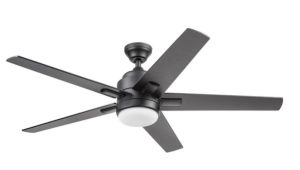
Harbor Breeze Flanagan II Ceiling Fan
The Harbor Breeze design catalog is genuinely broad, which is one of the brand’s real strengths. You can find Harbor Breeze fans in traditional styles with ornate blade brackets and warm metal finishes, contemporary styles with clean lines and brushed nickel or matte black finishes, rustic and farmhouse styles with distressed wood blades and aged bronze hardware, and transitional styles that sit comfortably between traditional and modern. The range of blade spans runs from 42 inches for smaller rooms up to 60 inches for larger spaces, with 52 inches being the most common and widely available size.
Finish options across the lineup include brushed nickel, matte black, oil-rubbed bronze, antique bronze, white, and various two-tone combinations. Many Harbor Breeze fans feature reversible blades that offer two different wood tones or finishes, which provides some flexibility if your décor changes over time or if you’re not certain which finish will look best in the space before you install the fan. The reversible blade feature is more common at the entry and mid-range price points and less common on the premium side of the lineup where blade design is typically fixed.
For outdoor use, Harbor Breeze offers fans with damp-rated and wet-rated certifications. Damp-rated fans can handle humidity and indirect moisture exposure — covered porches, screened enclosures, and similar sheltered outdoor spaces. Wet-rated fans can handle direct exposure to rain and are suitable for open pergolas and uncovered outdoor areas. Never install an indoor-only fan in an outdoor location, even a covered one, as the humidity and temperature cycling will degrade the motor and wiring significantly faster than normal indoor use.
Harbor Breeze Light Kits
Most Harbor Breeze fans are available with an integrated light kit, and for many buyers the lighting function is just as important as the airflow — particularly in rooms where the ceiling fan is the primary overhead light source. Harbor Breeze light kits range from simple single-light configurations to three and four-light arrangements with frosted glass shades, alabaster glass, or decorative globes depending on the fan model and style.
One thing worth knowing upfront is that Harbor Breeze light kits are not universally interchangeable between fan models. The fitter size — the diameter of the mounting opening on the fan’s switch housing — varies between models, with 2.25 inches and 3.25 inches being the most common sizes. A light kit that fits one Harbor Breeze fan may not fit another even if they look similar from the outside, so always confirm your fan’s fitter size before ordering a replacement or upgrade kit. The fan’s model number, printed on the rating label inside the motor housing, is the most reliable way to confirm compatibility.
Many current Harbor Breeze fans ship with LED-compatible or fully integrated LED light kits, which is a meaningful practical advantage over older incandescent designs. Integrated LED kits eliminate the need for bulb replacements for many years of normal use, draw significantly less electricity than equivalent incandescent setups, and produce consistent light quality without the color shift that incandescent bulbs develop as they age. If you’re replacing an older incandescent light kit on an existing Harbor Breeze fan, upgrading to an LED kit at the same time is generally worth the modest additional cost.
Light kit failures are one of the most common Harbor Breeze support issues, and most of them are fixable without replacing the entire kit — a failed pull chain switch, a loose wire connection inside the canopy, or a compatibility conflict between LED bulbs and a dimmer switch accounts for the majority of light kit problems people encounter. For a full breakdown of what goes wrong with Harbor Breeze light kits, how to diagnose the problem, and which replacement kits are currently available, see our dedicated Harbor Breeze Light Kits page.
Remote Controls and Smart Features
Most mid-range and higher Harbor Breeze fans come with remote control systems, and understanding how these systems work saves a lot of frustration if you ever need to troubleshoot or replace a remote. Harbor Breeze remote systems consist of two components: the handheld remote and a receiver module that’s installed inside the fan’s canopy during installation. The remote sends a radio signal to the receiver, which then controls the fan’s speed and light functions.
Older Harbor Breeze fans — roughly those manufactured before 2015 — use a DIP switch system to set the communication channel between the remote and receiver. DIP switches are tiny physical toggles inside both the remote’s battery compartment and the receiver housing, and they need to be set to identical positions for the remote and fan to communicate. This is a simple, reliable system that never needs software updates, but the switches are small and easy to accidentally move, and matching them incorrectly is the most common cause of remote problems in older Harbor Breeze fans.
Newer Harbor Breeze fans use digital frequency pairing instead, where you press a learn button on the receiver to put it into pairing mode and then send a signal from the remote to synchronize the two devices. This system is generally easier to use but can be finicky about the timing sequence — the pairing window is short and if you miss it you have to start over. If your new fan’s remote isn’t working out of the box, the pairing process is almost always the first thing to check rather than assuming the remote or receiver is defective.
Some current Harbor Breeze models support smart home integration, allowing control through Wi-Fi connected apps or voice assistants. These models are toward the higher end of the Harbor Breeze price range and require a compatible receiver and app setup. The smart home integration is functional rather than exceptional — it works reliably for basic on/off and speed control but doesn’t offer the depth of scheduling, automation, and scene integration that dedicated smart home ceiling fan brands provide.
Build Quality and Longevity
Harbor Breeze fans are built to a price point, and the build quality reflects that honestly. Entry-level models use lightweight plastic components in the blade brackets and canopy housing that feel less substantial than fans from premium brands, and the motors in budget AC models are designed for adequacy rather than longevity under heavy use. That said, “built to a price point” doesn’t mean “built to fail” — Harbor Breeze fans routinely run for ten or more years under normal residential use without major issues, and many homeowners have Harbor Breeze fans that have been running trouble-free for fifteen or twenty years.
The mid-range DC motor models are noticeably better built than the entry-level AC models — the motor housings feel more solid, the components fit together more precisely, and the overall impression is of a product that was engineered with more care. If you’re buying a Harbor Breeze fan for a high-use location like a living room or bedroom where it will run for many hours daily, investing in a mid-range model over a budget one is worth the additional cost in terms of both longevity and the quality of the daily experience.
Replacement Parts and Long-Term Support
This is an area where Harbor Breeze has a genuine weakness relative to brands like Hunter that operate their own dedicated parts distribution systems. Because Harbor Breeze is a Lowe’s house brand rather than an independent manufacturer’s brand, parts availability depends on what Lowe’s and Litex Industries choose to keep stocked — and for older or discontinued models, that availability diminishes over time. Finding an exact replacement remote, receiver, or light kit for a Harbor Breeze fan that’s five or more years old can range from straightforward to genuinely difficult depending on the specific model.
The practical mitigation for this is to keep your fan’s model number documented from the start — write it down, photograph the motor housing label, store it somewhere you’ll find it. The model number is your key to finding compatible parts through Lowe’s, through Litex Industries directly, and through third-party parts suppliers who stock Harbor Breeze compatible components. Universal replacement remotes and receivers are available that work with most Harbor Breeze fans regardless of the original part number, which provides a fallback option when original parts are unavailable.
For light kit replacements specifically, the fitter size (the diameter of the mounting opening on the fan’s switch housing) is the critical specification — 2.25 inches and 3.25 inches are the most common sizes, and any light kit with the matching fitter size from a compatible manufacturer will typically work even if it’s not a Harbor Breeze branded part.
Harbor Breeze vs. The Competition
Compared to Hampton Bay — the other major big-box-store ceiling fan house brand, sold through Home Depot — Harbor Breeze occupies a very similar market position with comparable quality at comparable prices. The practical difference for most buyers is simply which store you prefer to shop at, since the product tiers, price points, and overall quality levels are genuinely similar between the two brands. Parts availability for both brands has the same limitation of being tied to retail availability rather than a dedicated manufacturer’s parts program.
Compared to Hunter — an independent ceiling fan brand with its own distribution and parts program — Harbor Breeze is generally less expensive at equivalent quality tiers, but Hunter has an advantage in long-term parts availability and a dedicated customer support infrastructure that Harbor Breeze can’t fully match. If parts availability and long-term support are important to you, Hunter is worth the moderate price premium over Harbor Breeze.
Compared to premium brands like Minka Aire, Kichler, or Casablanca, Harbor Breeze doesn’t compete on build quality, motor sophistication, or design refinement — but it also doesn’t compete on price. A Minka Aire fan at $400 or more is a different product category entirely, and Harbor Breeze is the right answer for buyers who want a reliable, attractive ceiling fan without spending premium prices.
Harbor Breeze is a good brand for what it is: an accessible, broadly available, reasonably well-made ceiling fan line sold through a single major retailer at prices most homeowners can comfortably justify. The entry-level fans are adequate for basic applications. The mid-range DC motor models are genuinely good fans that perform well and run quietly for years. The design catalog is broad enough that most people can find something that suits their space without compromise.
The limitations are real but manageable: parts availability for older models requires some hunting, the warranty and support experience runs through Lowe’s rather than a dedicated manufacturer’s program, and the build quality at the budget end of the lineup reflects the price point honestly. Go in knowing what you’re buying and Harbor Breeze will serve you well. Expect premium quality at budget prices and you’ll be disappointed.