
Kichler Lighting has been in business since 1938, and ceiling fans are one part of a much broader product range that includes decorative lighting, outdoor lighting, and architectural hardware. That context matters for understanding what Kichler ceiling fans actually are: they’re designed to coordinate with lighting and décor systems rather than exist as standalone appliances, which is why Kichler fans tend to have more considered finishes, coordinated light kit options, and design details that connect to the wider Kichler product catalog. They occupy a genuine mid-to-upper position in the residential ceiling fan market — better motor quality, finish durability, and design integration than big-box store house brands, but priced and distributed to remain accessible to homeowners rather than exclusively to contractors and designers.
Where Kichler Fits in the Ceiling Fan Market
The ceiling fan market broadly breaks into three tiers: entry-level fans sold at Home Depot and Lowe’s under brands like Hampton Bay and Harbor Breeze, mid-range brands like Hunter and Kichler that offer genuine quality improvements over entry-level without premium pricing, and high-end brands like Casablanca and Minka Aire where design and motor quality command significantly higher prices. Kichler sits in the upper portion of that middle tier, occasionally overlapping with the premium end depending on the series. What you get for the price difference over entry-level brands is primarily motor quality — Kichler uses DC motors in many of their mid-range and upper-range models, which run quieter, consume 60–70% less electricity than older AC motor designs, and tend to last longer under continuous use. Their finishes also hold up better over time than the painted finishes on entry-level fans, which matters particularly for fans in kitchens, bathrooms, or humid environments.
Kichler Ceiling Fan Series
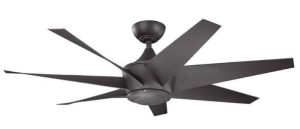
Kichler produces a large number of fan series at any given time, with regular additions and retirements. The Canfield has been one of their most enduring and widely installed residential lines — a traditionally styled fan available in 42-inch and 52-inch blade spans, multiple finishes, and with good parts availability that comes from years of continuous production. The Canfield’s broad distribution and long production run mean that replacement blades, light kits, and remotes are genuinely findable through Kichler’s parts channel, which is a practical advantage over more niche or recently discontinued models. The Lehr 80-inch is at the opposite end of the size spectrum — an 80-inch blade span designed for great rooms, vaulted spaces, and large open-concept areas where a standard 52-inch fan simply can’t move enough air to be effective. At that size, structural installation requirements and ceiling height minimums become serious planning considerations. Kichler’s outdoor line, including damp-rated and wet-rated models, covers covered porches, patios, and pergolas with fans built to handle humidity and temperature cycling without the finish and motor degradation that happens when indoor fans are used in outdoor conditions.
Kichler also produces fandeliers — combination ceiling fan and chandelier fixtures where the fan motor and blade assembly is integrated into a chandelier design rather than a conventional fan housing. These are genuinely distinct from bolt-on light kits attached to a fan motor, because the design is conceived as a single decorative unit from the start. They work well in dining rooms, entryways, and formal living spaces where a chandelier is the right decorative choice but air circulation is also needed — spaces where a conventional ceiling fan would look out of place but doing nothing about air movement is uncomfortable. The trade-off is that fandeliers are more complex installations, harder to find replacement parts for, and the airflow performance is typically secondary to the chandelier aesthetic.
Kichler’s Controls Ecosystem
One area where Kichler is more complex than simpler fan brands is their controls. Many Kichler models use proprietary receiver modules that pair with specific remote controls via DIP switch settings. The receiver module — the small electronic component that mounts inside the canopy and interprets remote signals — determines which remotes are compatible, and compatibility isn’t universal across all Kichler fans or all Kichler remotes. In multi-fan homes, getting DIP switch settings correct on each receiver and its corresponding remote is essential to prevent one remote from controlling the wrong fan. Kichler wall controls introduce another layer of compatibility considerations, since not all Kichler fans support wall control operation and matching the control to the fan’s motor type (AC versus DC) is required for correct function.
Smart home integration is available on select current Kichler models through compatibility with platforms including Amazon Alexa and Google Home, typically via a smart receiver module that replaces the standard receiver inside the canopy. This is an add-on capability on supported models rather than a built-in feature across the lineup, so checking smart compatibility for a specific model before purchase is worth doing if home automation integration matters.
Common Kichler Ceiling Fan Problems
Wobbling is the most common complaint on Kichler fans, and in most cases the cause is mechanical rather than a defect — loose blade bracket screws are the first thing to check, since normal vibration works fasteners loose over time, and even small amounts of blade movement at the bracket creates wobble that amplifies at the blade tip. Cleaning all blades evenly before doing anything else is worth doing because uneven dust accumulation across blades is a surprisingly common source of balance problems. After cleaning and tightening, a blade balancing kit — the adhesive weights that clip to the blade edge — can correct remaining minor imbalance.
Remote control problems on Kichler fans almost always trace back to one of three causes: dead or weak batteries (the most common cause by far and always worth eliminating first), DIP switch mismatch between the remote and the receiver module, or a failed receiver module. Re-pairing the remote by matching DIP switch positions between the remote and the receiver resolves the majority of cases where battery replacement doesn’t. Receiver module failure is less common but does happen, and replacement receivers are available for most current Kichler models through Kichler’s parts channel or authorized dealers.
Clicking and ticking noises typically come from loose mounting hardware, unbalanced blades creating cyclic vibration, or pull chains making contact with the fan body at certain speeds. Checking all visible screws and mounting points is the right first step, followed by blade balance if tightening doesn’t resolve it. A clicking noise that occurs only at specific speeds and stops when the fan is running faster or slower is usually a resonance issue — the fan’s vibration at that speed is hitting a frequency that causes a loose component to tap — and methodically checking blade brackets, canopy screws, and light kit hardware will usually find it.
Parts and Warranty
Kichler offers a limited lifetime motor warranty on their ceiling fans, which is a meaningful indicator of motor quality confidence — not all ceiling fan manufacturers back their motors with lifetime coverage. Parts support for current and recent Kichler models is generally good through Kichler’s customer service line and authorized dealers, covering blades, blade brackets, light kits, remotes, and receiver modules. For discontinued models the availability narrows over time, so recording the model number from the label inside the motor housing canopy is worth doing while the fan is accessible — it’s the information you’ll need when something eventually requires replacement.
Kichler’s parts are model-specific in important ways. Blades from one Kichler series don’t necessarily fit another, remotes pair to specific receiver types, and light kits aren’t universally interchangeable across the lineup. When sourcing replacement parts, confirming compatibility by model number rather than assuming a Kichler part will fit any Kichler fan prevents wasted purchases and return shipping.