Hampton Bay Universal Ceiling Fan Thermostatic Remote Control Kit for HD3 TR222A 98108 98130 98101 98131
Description
Step up from the basic Hampton Bay portable remote and you land here — the Universal Ceiling Fan Thermostatic Remote Control Kit, sold under the HD3 TR222A designation and appearing in Hampton Bay’s catalog under model numbers 98108, 98130, 98101, and 98131 depending on the retail configuration and packaging revision. The thermostatic feature is the headline, and it’s what separates this kit from the standard speed-and-light remotes that make up most of the retrofit remote market. Instead of simply giving you wireless control over your fan’s speed, this system adds an onboard thermostat that monitors ambient room temperature and automatically adjusts fan operation to maintain a set target. It sounds like a premium feature, and in the context of ceiling fan accessories under fifty dollars, it genuinely is.
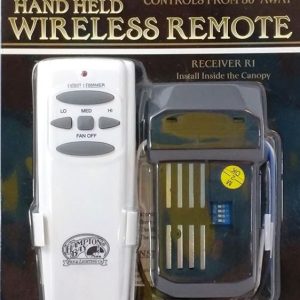
The physical kit follows the same two-component structure as Hampton Bay’s simpler remote offerings — a handheld transmitter and a receiver module that installs inside the canopy. The receiver is slightly bulkier than the basic model owing to the additional circuitry required for thermostat functionality, and this is worth keeping in mind before you order if your fan has a particularly shallow or compact canopy. In most standard Hampton Bay installations there’s adequate clearance, but if you’re working with an older fan or a flush-mount design, measure the available depth inside your canopy before committing. Installation follows the same process as any retrofit receiver kit: breaker off, canopy dropped, existing wiring disconnected, receiver spliced into the circuit per the included diagram, canopy restored. For someone comfortable with basic residential wiring it’s a straightforward job, and the instructions are clear enough to guide a careful first-timer through without much anxiety.
The thermostat is the reason most people reach for this kit over a standard remote, and it’s worth understanding how it actually works before you buy. The temperature sensor is built into the receiver unit inside the canopy, not into the handheld remote, which means it’s reading the temperature at ceiling level rather than at the living zone where you’re actually sitting. In rooms with good air circulation this distinction matters less, but in spaces with significant temperature stratification — where warm air pools near the ceiling — the sensor may read several degrees higher than what you’re experiencing at sitting height. Hampton Bay accounts for this by letting you set a target temperature on the remote, and in practice most users find they need to set the thermostat a few degrees lower than their actual comfort target to get the fan cycling the way they want. It takes a brief calibration period of a day or two to dial in, but once you have it set, the system runs reliably on its own.
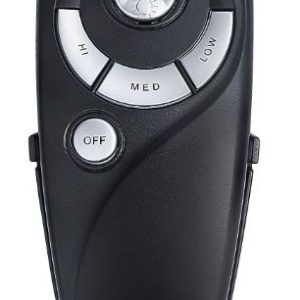
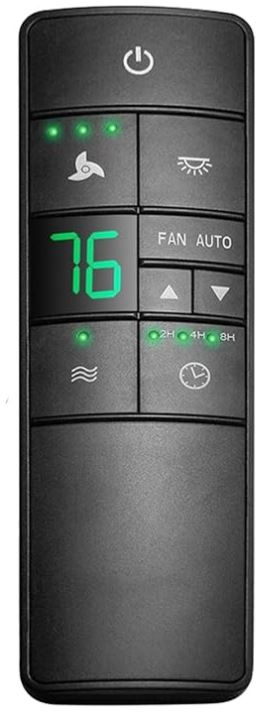
The remote transmitter itself is well-designed for a product in this price range. The layout gives you clearly labeled buttons for fan speed selection — high, medium, and low, plus off — along with light control, and the thermostat controls for setting your target temperature and toggling the auto mode on and off. The temperature display on the remote shows the current reading from the receiver sensor, which is useful both for monitoring and for understanding why the fan is or isn’t running at any given moment. The button travel is positive and deliberate, the labeling is large enough to read across a dim room, and the overall build quality feels appropriately solid — not premium, but not cheap either. It runs on AA batteries rather than the 9-volt used by the basic remote, which is a minor convenience since AA cells are more commonly on hand.
Range performance on the HD3 TR222A is consistent with what Hampton Bay advertises for this line — approximately forty feet with reliable penetration through a single interior wall. In practical residential use, that covers any room you’d realistically be trying to control a ceiling fan from. Response time between button press and fan response is essentially instantaneous, and the thermostatic cycling is smooth rather than abrupt — when the room temperature climbs above your set point, the fan ramps up gradually rather than snapping to high speed, which prevents the jarring experience you sometimes get with cheaper thermostat systems. When the temperature drops back below the threshold, the fan steps back down or shuts off depending on how you’ve configured the settings. The whole system has a calm, considered quality to it that makes it easy to forget it’s doing anything at all, which is exactly what you want from an automation feature.
Compatibility follows the same logic as Hampton Bay’s other retrofit remote kits, and the “universal” designation is reasonably accurate within its defined scope. The HD3 TR222A is designed for single-capacitor motors on a single switched circuit — meaning the wall switch controls power to the whole fan and the remote handles all the function control from there. It is not compatible with fans wired for separate wall-switch control of the fan and light independently. It works across Hampton Bay’s own lineup with very high consistency and also pairs successfully with fans from other major brands including Hunter, Harbor Breeze, and a wide range of generic and builder-grade fans, provided the wiring configuration matches. The dip switch pairing system is the same as the rest of Hampton Bay’s remote family — set matching positions on the transmitter and receiver, and the link is established without any digital handshaking or app involvement.
The thermostat function earns its keep most visibly in bedrooms and home offices — spaces where you want a consistent ambient temperature without having to think about it. In a bedroom particularly, the ability to set a target temperature and let the fan manage itself overnight is a genuine comfort improvement. You fall asleep at whatever speed the room currently requires, and if the temperature drops in the early morning hours, the fan steps back or shuts off without waking you to do it manually. It’s the kind of feature that sounds modest on paper and proves its value quickly in practice. For living rooms and great rooms where people move in and out frequently and comfort preferences vary, the thermostatic mode is still useful but the manual speed control tends to get more use, and the kit handles both modes equally well.
At the price point — typically between $35 and $50 depending on where you buy and which model number configuration you land on — the Hampton Bay Universal Ceiling Fan Thermostatic Remote Control Kit represents genuine value for anyone who wants to add intelligent automation to an existing ceiling fan without committing to a full smart home ecosystem. It doesn’t require a hub, a subscription, a Wi-Fi network, or a smartphone. The thermostat works independently of everything else in your house, draws minimal power, and does its job without drama. If you already own a Hampton Bay fan on a single-circuit wall switch and you spend meaningful time in the room it serves, the step up from a basic remote to this thermostatic kit is worth every additional dollar. The convenience of set-and-forget temperature management is one of those quality-of-life improvements that quietly earns its cost back over the course of a single summer.