Hampton Bay Portable Ceiling Fan Remote Control
$55.00
Description
There’s a particular kind of frustration that comes with a ceiling fan you can’t control from across the room. You’re settled in, the lights are off, and the fan is running one speed too fast or one speed too slow, and the only way to fix it is to get up, pull a chain in the dark, and hope you land on the right setting. The Hampton Bay Portable Ceiling Fan Remote Control exists specifically to solve that problem, and for the price — typically under $30 — it does a remarkably competent job of it. It’s not a flashy product. There’s no app, no voice integration, no scheduling. What it is, is a straightforward retrofit remote kit that adds wireless control to a fan that didn’t have it, and for most people in most situations, that’s exactly what they needed.
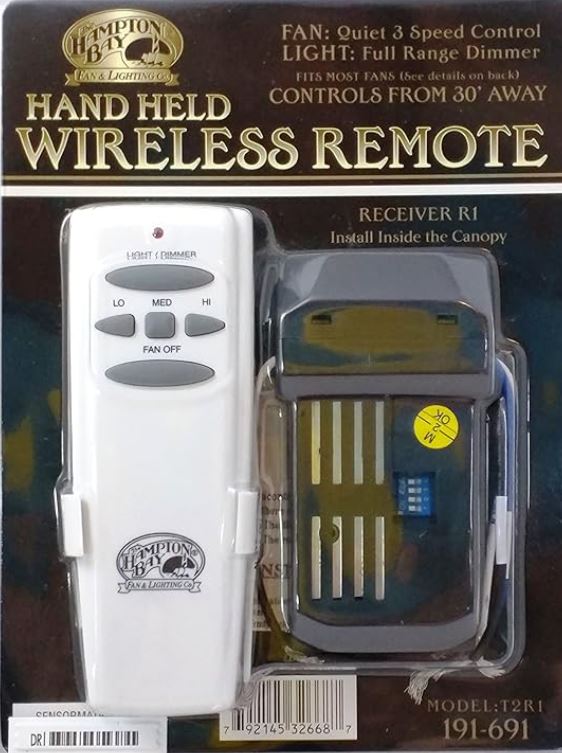
The kit ships with two components: the handheld remote transmitter and a receiver module that installs inside the canopy of your existing fan. Installation is the first real test of any retrofit remote kit, and this one passes without much drama. You cut power at the breaker, drop the canopy, disconnect the existing wiring, splice the receiver into the circuit according to the included diagram, tuck it up into the canopy, and restore power. The whole process takes around twenty minutes for someone reasonably comfortable with basic electrical work, and the included instructions are clear enough that a first-timer willing to read carefully shouldn’t have much trouble. The receiver is compact enough to fit inside canopies that aren’t particularly deep, which matters on older or lower-profile fan designs where space is tight.
Pairing the remote to the receiver is handled through a set of dip switches — small physical toggles inside both the remote battery compartment and on the receiver itself. You set them to matching positions on both units, and that’s your pairing. It’s a decidedly low-tech approach compared to the Bluetooth and RF auto-pairing you find on premium remote systems, but it has a real practical advantage: it’s stable. There’s no handshake protocol to fail, no firmware to update, no connection that drops when someone’s phone interferes. Once the dip switches are set, the remote talks to that receiver and only that receiver, reliably, every time. If you’re running multiple Hampton Bay fans in the same house, you set each receiver to a different dip switch combination, and there’s no cross-talk between them.
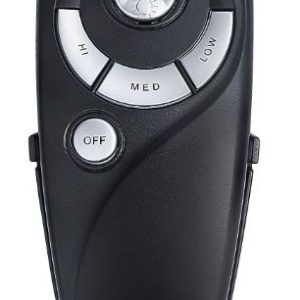
The remote itself is a compact unit, roughly the size of a thick TV remote, with clearly labeled buttons for fan speed — high, medium, and low — along with an on/off button and a light control. The light control on compatible installations provides full-range dimming, which is a genuine quality-of-life improvement over the binary on/off that most pull-chain fans offer. The buttons have a satisfying tactile click and are spaced far enough apart that you’re not accidentally hitting the wrong one in the dark. The remote takes a 9-volt battery, which is included in the package, and battery life is good — under normal use you’re looking at a year or more before replacement is necessary.
Range is one of the areas where this remote performs better than its price point would suggest. Hampton Bay rates it at around forty feet, and in real-world use through standard interior walls, that holds up well. It’s not going to reach from the master bedroom to the living room in a large house, but it will absolutely cover any reasonable room size, and the signal penetrates a single interior wall without noticeable degradation. The response is immediate — there’s no perceptible lag between pressing a button and the fan responding, which sounds like a minor thing until you’ve used a cheap remote system where every command requires a second press to confirm it registered.
Compatibility is worth discussing because it’s the area where buyers most often run into trouble with retrofit remote kits. The Hampton Bay Portable Remote is designed to work with single-capacitor motors, which covers the vast majority of Hampton Bay fans and a large portion of fans from other brands. It will not work correctly with fans that have separate wiring for the fan and light functions at the wall — those require a dual-circuit remote system. It also won’t pair with fans that already have an existing receiver installed unless you remove the old receiver first. Read your fan’s wiring before you order. If your wall switch controls the fan and light on a single wire, this remote will almost certainly work. If you have two separate switches for fan and light, you need a different kit.
One thing worth noting for Hampton Bay fans specifically is that this remote integrates cleanly into the Hampton Bay ecosystem. If you ever need to replace just the remote — say it gets dropped and the casing cracks, or a child loses it — you can order a replacement transmitter set to the same dip switch configuration and it picks up right where the old one left off. You don’t need to touch the receiver or rewire anything. That kind of parts availability and forward compatibility is one of the genuine advantages of staying within the Hampton Bay family, where the brand’s Home Depot exclusivity means the supporting accessories stay stocked and accessible for years after you install the fan.
For what it is and what it costs, the Hampton Bay Portable Ceiling Fan Remote Control is a solid, no-nonsense product that delivers exactly what it promises. It won’t impress anyone looking for smart home integration or app control, and if that’s what you need, you should be looking at a different product category entirely. But if you have a functioning ceiling fan with a pull chain, a room you spend real time in, and thirty dollars to spend on a meaningful quality-of-life improvement, this kit earns its place. The installation is manageable, the reliability is excellent, and the convenience of controlling fan speed and light level from anywhere in the room without leaving your chair is one of those small domestic upgrades that turns out to matter more than you expected.