
The dark brown finish on the Fasco Charleston Model 438 is the least neutral and most period-specific color option in the Charleston lineup. Where white worked in almost any room and antique brass suited warm traditional decors, dark brown was a deliberate choice for a particular kind of early 1980s interior that was once extremely common and is now more difficult to find in original form. Understanding the dark brown 438 requires understanding the room it was built for, which in turn requires understanding a decorating philosophy that defined a substantial share of American residential interiors in the early part of the decade.
The dark brown ceiling fan was a natural companion to the wood-paneled dens, earth-tone color schemes, and heavy wood furniture that characterized mainstream American interior decoration in the late 1970s and early 1980s. This was an era when dark stained wood was aspirational rather than dated, when brown was a primary rather than a background color in residential spaces, and when matching ceiling hardware to the wood tones of furniture, trim, and paneling was considered good design practice rather than an excess of coordination. The dark brown Charleston 438 was built for exactly this environment, and it succeeded in that context in a way that no lighter-colored fan could have matched.
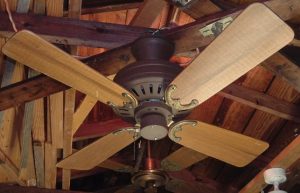
The Dark Brown Finish and Its Relationship to Period Interior Design
The dark brown finish on the 438 covers the motor housing and associated hardware in a tone that reads as a medium to dark walnut or espresso, depending on the lighting conditions and the specific aging of the particular fan. This range of apparent tone is partly a function of how the finish has aged and partly a function of how the original finish was specified and applied. Fasco’s dark brown is a richer, warmer tone than simple black while being distinctly darker than medium browns or bronze finishes, which gives it a specific visual weight that suits heavy wood furniture and dark-stained paneling more naturally than the lighter options in the Charleston lineup.
Dark finishes on ceiling fans present different maintenance and evaluation challenges than lighter finishes. Surface contamination like dust, oil residue, and airborne grease from cooking environments is more visible on dark surfaces under certain lighting conditions, but the dark finish also hides minor surface imperfections and small areas of finish wear that would be conspicuous on a white fan. The net effect is that dark brown fans can appear in better condition than they are under casual inspection and may also hide actual problems that are revealed only under close examination with adequate lighting.
The blade irons on the dark brown 438 are finished to match the motor housing, which means they share the same finish specification and will age in a similar way. The blade irons are more exposed to air circulation and handling than the motor housing, and on dark brown fans they are sometimes the first component to show significant finish wear. Replacement blade irons in a matching dark tone are available from vintage fan parts suppliers but may not be identical to the original Fasco specification in finish depth or sheen level.
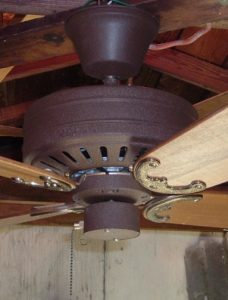
Mechanical Consistency Across the Charleston 438 Color Variants
The dark brown 438 is mechanically identical to the white variant. The same ball and socket mounting system with bell canopy, the same three-speed pull chain with forward and reverse switch on the motor housing, and the same motor with its characteristic very slow low speed are all present. Fasco built the Charleston on a common mechanical platform across all colors and the dark brown version reflects this approach, with finish being the only substantive difference between it and the white 438.
The forward and reverse switch on the dark brown 438 motor housing is finished in the dark brown tone of the housing, which maintains the visual consistency of the fan when viewed from below. This switch is a physical toggle that changes the direction of motor rotation, and on the dark brown version it is integrated into the overall dark presentation of the motor housing rather than standing out as a contrasting element. The pull chain and its hardware are typically finished in a complementary tone on this variant as well, though chain replacement over the decades has sometimes introduced non-original hardware that may not match the original dark finish.
The very slow low speed that defines the Charleston series operationally is present on the dark brown 438 in the same form as on all other Charleston variants. This slow speed setting is one of the primary reasons collectors and enthusiasts seek out Charleston fans for actual use rather than display, and the dark brown 438 provides it with the same mechanical reliability as the white version. A dark brown Charleston running at low speed in a wood-paneled room with period-appropriate furniture is about as close to an authentic early 1980s interior experience as can be achieved with a functional ceiling fan.
Finding and Evaluating a Dark Brown Fasco Charleston 438
Dark brown Charleston 438 fans appear less frequently in the collector market than white variants, which makes them worth acquiring when a clean example surfaces. The relative scarcity stems from several factors including the general decline in popularity of dark brown as an interior color from the mid 1980s onward, which led to more of these fans being removed and disposed of during room renovations than white fans that could be repainted over or left in place as a neutral element. Fans that survived in original installations in rooms that were never significantly renovated are the most likely source of clean dark brown examples today.
Condition evaluation for the dark brown 438 should pay particular attention to the finish under good lighting. Dark finishes can hide significant wear that is invisible under the low-angle lighting typical of ceiling fan inspection conditions. Examining the motor housing under a direct light source at multiple angles will reveal finish condition more accurately than overhead or ambient lighting alone. Look specifically for areas where the dark finish has worn through to show the underlying material, which appears as lighter patches or areas with a metallic sheen that differs from the surrounding finish.
The blade set associated with original dark brown 438 installations was typically in wood tones that complemented the dark housing. Walnut finish or dark stained wood blades are the most period-appropriate pairing and the most likely original configuration. Finding a dark brown 438 with its original dark wood blades in good condition provides the most complete and authentic presentation of the fan as it would have appeared in an early 1980s installation. Blades in significantly different tones or in clearly non-period finishes suggest replacement at some point in the fan’s history and should be noted in any documentation of the example.
The Dark Brown 438 and Its Place in the Charleston Production Picture
The Charleston Model 438 in dark brown represents one of the more specific market targeting decisions in the Fasco Charleston lineup. The decision to offer this finish reflects an understanding that the ceiling fan market of the early 1980s was not monolithic in its design preferences and that different color options served genuinely different customer populations. The white fan served contemporary and neutral interiors. The antique brass served traditional and warm-toned rooms. The cream and brass served transitional spaces that wanted warmth without full brass commitment. The dark brown served the wood-heavy, earth-toned, heavily furnished spaces that were the dominant interior type in mainstream American homes of the period.
Fasco’s willingness to offer this range of finishes on the Charleston series reflects both manufacturing competence and market awareness. Each finish variant required its own production run with different materials and processes, which added complexity and cost to the manufacturing operation. That Fasco accepted this complexity rather than limiting the Charleston to one or two neutral finishes suggests the company was genuinely responsive to the market rather than simply producing a fan and hoping buyers would accept it in whatever color it came in.
The dark brown 438 also reflects the moment in ceiling fan history when the product was making the transition from a functional appliance to an interior design element. A company that thought of ceiling fans purely as appliances would not have invested in a dark brown finish variant. The investment in finish variety signals that Fasco understood its customers were making purchasing decisions partly on aesthetic grounds and was prepared to serve those decisions with appropriate options.
Running and Maintaining the Dark Brown Charleston 438
A dark brown Fasco Charleston 438 in working condition performs identically to other Charleston 438 variants. The motor is quiet, the three-speed range is useful for seasonal variation, and the very slow low speed setting provides the gentle air movement that the Charleston series is known for. Operating a dark brown 438 in a period-appropriate room is a genuinely pleasant experience that demonstrates why these fans developed the loyal following they have among vintage ceiling fan enthusiasts.
Maintenance for the dark brown 438 follows the standard Charleston maintenance framework. Capacitor testing and replacement as needed addresses the most common mechanical failure mode. Pull chain switch inspection and replacement handles the most common control system issue. Motor lubrication through available oiling ports can reduce operating noise and extend bearing life on fans that have been in storage. Blade inspection and balancing correction ensures smooth operation with minimal vibration.
The dark brown finish itself requires no special maintenance beyond cleaning, though cleaning methods should be appropriate for painted surfaces. Abrasive cleaners or tools will damage the finish, while gentle cleaning with appropriate products will remove surface contamination without affecting the underlying finish. For fans that will be used rather than displayed, some finish wear is inevitable over time and should be accepted as part of the character that comes with genuine age rather than treated as a defect requiring correction.
The Fasco Charleston Model 438 in dark brown is a fan that carries its period specificity as a virtue rather than a limitation. It was built for a room type that was once universal and is now historical, which gives it the appeal of a genuine artifact from a specific moment in American domestic life. For collectors and enthusiasts who appreciate that kind of historical specificity in a functional object, the dark brown Charleston 438 is worth the patience required to find a clean example.