
The Hampton Bay Cressner is a 60-inch ceiling fan that has earned a lasting reputation among homeowners who value traditional styling and reliable everyday performance. Sold exclusively through Home Depot under the Hampton Bay store brand, the Cressner was designed for larger rooms where a standard 52-inch fan would leave the space feeling underpowered. It has since been discontinued, but it remains a common fixture in homes across North America and continues to generate a steady stream of questions about replacement parts, light kit compatibility, and long-term maintenance. This review covers everything a current or prospective Cressner owner needs to know about what the fan does well, where it has limitations, and how it holds up years after installation.
Design and Appearance
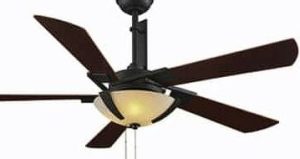
The Cressner’s most immediately noticeable feature is its five mahogany blades, which give the fan a warm, traditional character that suits living rooms, dining rooms, and bedrooms decorated in transitional or classic styles. The blades are finished in a deep reddish-brown tone that reads as genuinely wood-like rather than the flat, printed-laminate look that became common in lower-cost ceiling fans during the same era. The hardware and motor housing are finished to complement the blade aesthetic, and the concealed screws and mounting hardware contribute to a cleaner visual profile than fans that leave the blade arm attachment points exposed.
At 60 inches, the Cressner has a presence in a room that smaller fans simply cannot match. The blade span is appropriate for rooms in the 15 by 15 foot to 18 by 18 foot range, and the fan fills the visual field of the ceiling in a way that looks proportional rather than oversized. The light kit that ships with the fan is a modest but functional complement to the blade assembly, using candelabra-base bulbs to produce warm downward light that suits the fan’s overall aesthetic without calling too much attention to itself. The overall impression is of a fan designed with coherent visual intention rather than assembled from a catalog of generic parts, which is not something that can be said of every fan at Hampton Bay’s price point.
Motor Performance and Airflow
The Cressner uses a triple capacitor motor, which is a design choice that has a direct bearing on both operational noise and long-term reliability. Triple capacitor motors distribute the electrical load across three capacitors rather than relying on a single unit, which produces smoother speed transitions and reduces the strain on any one component. The practical result is that the Cressner runs quietly at all three speed settings, and the difference between speeds feels gradual and controlled rather than abrupt. Homeowners who have run the Cressner for many years consistently report that it remains quiet well into its operational life, which is the primary thing most people want from a bedroom or living room ceiling fan.
The 14-degree blade pitch is on the higher end for residential ceiling fans, which is a specification that directly affects how much air the blades move per revolution. A steeper blade pitch creates more drag on the motor but delivers noticeably better airflow at equivalent RPMs, and at 60 inches the Cressner moves a substantial volume of air even at its medium speed setting. For a room in the 250 to 350 square foot range, running the Cressner on medium is typically sufficient for effective air circulation during warm weather, with the high setting reserved for peak summer temperatures or rooms with higher than standard ceilings that require more aggressive airflow.
The motor is permanently lubricated and sealed, meaning it never requires oiling over its service life. This is worth noting because many homeowners with older fans from other manufacturers have had to deal with motor noise caused by dried lubricant, an issue the Cressner’s sealed motor design avoids entirely.
Installation and Mounting Flexibility
The Cressner ships with dual-mount capability, meaning it can be installed either on a standard downrod or in a close-mount configuration for rooms with lower ceilings. The downrod options available for the Cressner are 6-inch and 12-inch lengths in a 3/4-inch diameter, which are standard residential sizes and easy to source if a longer rod is needed for installation in a room with particularly high ceilings. The lead wires run 54 inches through the downrod, which is long enough to accommodate extended rod installations without pulling the wiring tight.
The installation process itself is consistent with other Hampton Bay fans of the same era: the mounting bracket attaches to a standard ceiling fan-rated electrical box, the canopy cover conceals the bracket and wiring, and the blade arms attach to the motor housing before the blades are mounted to the arms. Concealed screw hardware at the blade arm mounting points gives the finished installation a cleaner look than fans that leave visible fasteners on the underside of the blade arms. For a first-time installer working from the manual, the Cressner is not a complex installation, though a second person is helpful when lifting and positioning a 60-inch fan during the initial mounting phase.
The Reverse Function and Year-Round Usability
The Cressner includes a motor direction reverse switch, which is located on the motor housing and allows the fan to be set to either forward or reverse rotation. Forward rotation, which pushes air downward in a direct column toward the floor, is the standard summer setting that produces the wind-chill cooling effect associated with ceiling fans. Reverse rotation, which draws air upward and redistributes the warm air that pools near the ceiling during colder months, is the winter setting that helps reduce heating costs by improving the efficiency of forced-air or radiant heating systems.
The reverse function on the Cressner requires physically reaching up to the motor housing to flip the switch, which is a minor inconvenience compared to fans with remote-controlled direction reversal. For a fan that is typically used in a fixed installation over a dining table or in a bedroom, the seasonal nature of direction changes means this inconvenience is limited to twice per year, which most homeowners find entirely acceptable given the fan’s other qualities.
The Light Kit
The candelabra-base light kit that comes with the Cressner is functional but not the fan’s strongest feature. The original kit uses E12 sockets and produces adequate warm downlight for ambient illumination, though it was never designed to serve as the primary task lighting for a room. The glass shade design is traditional and appropriate to the fan’s overall aesthetic, but the limited lumen output of the candelabra configuration means that rooms relying primarily on ceiling fan lighting may want to supplement with additional fixtures.
Because the Cressner is discontinued, the original light kit is no longer available as a replacement part through Hampton Bay or Home Depot. Owners who need a new light kit have several practical options, from Hampton Bay’s current universal LED kits to period-appropriate alternatives sourced through eBay. A full breakdown of the available options, including compatibility notes for specific Hampton Bay universal kits, is covered in the dedicated guide to Hampton Bay Cressner Light Kits.
Noise Level and Day-to-Day Operation
The Cressner’s triple capacitor motor and 14-degree blade pitch work together in a way that produces an interesting operational characteristic: the fan moves more air per revolution than a shallower-pitched blade would, which means it can run at a lower speed setting to achieve the same effective airflow as a faster-spinning fan with less aggressive blade geometry. Lower RPM operation at equivalent airflow reduces motor noise and bearing wear simultaneously, which partly explains why Cressner fans installed in the late 1990s and early 2000s are still running quietly in many homes today.
The most common noise complaint associated with the Cressner over the long term is capacitor-related hum rather than motor or bearing noise. The triple capacitor design means there are three components that can eventually fail or degrade, and a failing capacitor produces a low electrical hum that can be distracting in a quiet room. Capacitor replacement is a straightforward repair for anyone comfortable with basic electrical work, and replacement capacitors are inexpensive and widely available. A comment from a longtime Cressner owner on record confirms that capacitor replacement was necessary on two separate fans after years of operation, which suggests this is a normal maintenance interval rather than a defect.
Parts Availability for a Discontinued Fan
The Cressner’s discontinued status creates some challenges for owners who need replacement components. The blades, blade arms, and light kit glass shades are no longer available through official Hampton Bay channels, and the original remote system, if the fan was purchased with one, may require a compatible replacement remote rather than an exact OEM match. The capacitors are not model-specific and can be replaced with generic units that match the original microfarad ratings, though confirming those ratings requires accessing the capacitor housing in the motor and reading the specifications from the component label.
The broader replacement parts market through Amazon and eBay covers most of what a Cressner owner is likely to need, including blade sets in comparable dimensions and finish, universal light kits that fit the switch cup, and replacement remotes that pair with the original receiver if one is present. The fan’s build quality means that most Cressner installations requiring attention need component replacement rather than whole-fan replacement, and the parts availability situation is better than it is for many discontinued fans of the same vintage.
Who the Cressner Is Right For
The Cressner was designed for homeowners who wanted a large-format ceiling fan with genuine visual character rather than the generic appearance of a budget fan. Its mahogany blades, concealed hardware, and traditional proportions make it a natural fit for rooms furnished in warm wood tones, colonial or craftsman styles, and traditional transitional decor. The 60-inch blade span means it is most appropriate for rooms in the 200 to 350 square foot range, and it is particularly well suited to spaces with eight to ten foot ceilings where the dual-mount option allows the fan to be positioned at an ideal distance from both the ceiling and the occupants of the room.
For a buyer coming across a used Cressner today, either in a home they have purchased or through a secondhand sale, the fan represents good value as long as the motor is running quietly and the capacitors are in working condition. Its operational performance holds up well against comparable current-production fans, and its traditional aesthetic has not dated in the way that some of the more contemporary Hampton Bay designs from the same period have. Homeowners who already have a Cressner installed and are maintaining it for the long term will find that the fan rewards attention to the capacitors and light kit as the primary maintenance points, and that the motor and blade assembly are likely to outlast both.