
The Fasco Charleston 452 is the most widely recognized model in the Fasco ceiling fan catalog and the one most likely to be encountered by collectors and enthusiasts working through estate sales, vintage fan dealers, and online auctions today. It represents Fasco ceiling fans at their most accessible, a model produced across multiple generations through the early to mid 1980s and distributed broadly enough that surviving examples remain findable even as the overall pool of vintage American ceiling fans shrinks with each passing decade. Understanding the Charleston 452 properly means understanding both what made it a commercial success during its production run and what makes it a rewarding fan to own and operate today.
Fasco Industries of Eldon, Missouri brought genuine motor manufacturing expertise to the residential ceiling fan category when the late 1970s energy crisis created mass consumer interest in passive cooling. The Charleston series was Fasco’s answer to the mainstream residential market, a fan built on a common mechanical platform with multiple finish options that allowed the same well-engineered motor to serve rooms with very different design requirements. The 452 model number anchors the core of that series, and the fan produced under that designation is a consistent and well-executed product that has aged well in both mechanical and aesthetic terms.
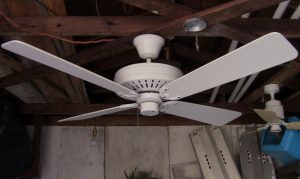
The Fasco Charleston 452: What the Model Number Covers
The 452 designation covers the core Charleston motor and mounting platform across multiple finish variants and two documented production generations. The white finish version is the most neutral and the most commonly found, the antique brass version is the most visually period-specific, and the cream and brass two-tone variant sold as the Model A452 addresses the design gap between the two. All of these variants share the same motor, the same ball and socket mounting system with bell canopy, and the same three-speed pull chain with forward and reverse switch on the motor housing. The model number identifies the mechanical platform; the finish suffix or prefix identifies the specific variant.
The second generation of the Charleston 452 runs through the early to mid 1980s and represents the production period when the design was fully mature and Fasco’s manufacturing volume for the Charleston series was at its peak. The third generation extends from the late 1980s into the early 1990s, with documented examples dated to May 1989. By the third generation, offshore manufacturing pressure was significantly affecting the American ceiling fan industry, and Fasco’s continued domestic production of the Charleston through this period reflects either committed customer demand or a manufacturing pipeline that had not yet been wound down. Both generations are mechanically comparable, and the distinction matters more for collection documentation than for day-to-day use.
The Ball and Socket Mounting System and Bell Canopy
The ball and socket mounting system with bell canopy is the defining visual and functional feature of the Charleston series. The system places a spherical ball at the top of the downrod assembly into a matching socket in the mounting bracket, allowing the fan to hang with a small degree of angular freedom that accommodates ceilings that are not perfectly level without producing visible misalignment in the hanging fan. This is a practical engineering solution to a real installation problem, and it works consistently across the range of ceiling conditions that residential installers encounter.
The bell canopy covers the junction box and mounting hardware with a curved form that transitions gracefully between the ceiling plane and the motor housing below. On white finish 452s the canopy matches the housing for visual unity. On antique brass examples the canopy carries the same warm finish as the housing, maintaining the two-tone visual coherence that made the brass Charleston attractive in period interiors. The canopy snaps into position against the ceiling and is held there by the weight of the fan pulling down through the ball and socket connection, which means there is no separate fastener required to secure it during installation.
Ceiling type compatibility for the Charleston 452 extends to angled ceiling installations within the degree range noted in the original Fasco installation documentation. The ball and socket system provides natural accommodation for mild ceiling angles that a rigid mounting system would not handle cleanly, and an angled ceiling adapter extends this range further for more pronounced pitched ceilings. This flexibility made the Charleston a practical choice for installation in rooms with architectural complexity that challenged simpler mounting systems.
Three-Speed Pull Chain and the Characteristic Very Slow Low Speed
The three-speed pull chain on the Charleston 452 cycles through high, medium, and low speed positions before returning to off. The pull chain mechanism is a straightforward electromechanical switch with no electronic components, which contributes significantly to its long-term reliability. Unlike electronic speed controls that can fail in complex ways that are difficult to diagnose and repair, a pull chain switch either works or it does not, and replacement switches of the correct type are available from ceiling fan parts suppliers when replacement is needed.
The low speed setting on the Fasco Charleston motor is genuinely very slow in a way that distinguishes it from most ceiling fans produced in the same period and from most contemporary fans produced today. This slow speed was engineered deliberately for commercial environments where ceiling fans needed to provide perceptible air movement without disturbing table settings, paper, candles, or conversation. Restaurants and bars were the primary intended commercial context, and the Charleston series achieved significant commercial installation on the strength of this operational characteristic.
In residential applications the very slow low speed proves most useful in bedrooms, where air circulation is desired for thermal comfort but where sound and wind sensation need to be minimized for sleep quality. A fan that can run at a genuinely slow speed without hunting, surging, or producing electrical noise is rare even among new production fans, and the Fasco motor achieves it through the quality of the induction motor winding rather than through electronic regulation. This is a mechanical virtue that collectors and enthusiasts consistently cite as one of the primary reasons they run Charleston fans rather than simply displaying them.
The forward and reverse switch on the motor housing is a physical toggle separate from the pull chain. Switching direction requires stopping the fan first to avoid mechanical stress, and on the Charleston the toggle is mounted on the motor housing itself rather than on the pull chain, which means changing between summer and winter modes requires reaching the housing. Most owners set the direction once per season and leave it, which is the intended pattern of use for this type of control.
Finish Variants and What Each One Suits
The white finish Charleston 452 is the most neutral and the most versatile of the available variants. White works in rooms with contemporary design, painted trim, lighter color palettes, and spaces where the homeowner wants the ceiling fan to recede visually rather than make a design statement. The white finish has also aged the most gracefully of the available options, since white does not develop the patina issues that brass finishes accumulate and does not carry the period-specific associations that make brass variants read as products of a specific era.
The antique brass finish variant is the most visually distinctive and the most period-appropriate for early 1980s interiors decorated in warm tones with traditional furniture and brass hardware appointments throughout. The antique brass differs from polished brass in that it intentionally incorporates a darkened patina that reads as warm rather than flashy, which made it more compatible with a wider range of room conditions than high-gloss polished brass alternatives. Surviving antique brass examples that have been kept in climate-controlled spaces have developed deeper, more complex patinas that many collectors find more attractive than the original factory finish.
The Model A452 in cream and brass is the two-tone variant that bridges the gap between the all-white and all-brass options. The cream motor housing is a warm off-white rather than a pure white, which softens the contrast between the housing color and the brass hardware enough to create visual unity rather than stark contrast. Documented examples of the A452 carry production dates from March 1985, suggesting this finish combination was introduced at mid-decade when the market had moved toward finishes that offered warmth without the full visual commitment of all-brass. It is somewhat less commonly found than the white or antique brass variants, giving it moderate collector interest beyond its standard appeal.
The Charleston 452 Motor and Why It Holds Up
The motor in the Charleston 452 is built on the K55-type stack motor platform that Fasco applied across its residential ceiling fan lineup. This is an induction motor design with oil-lubricated sleeve bearings rather than the sealed ball bearings used in cheaper fans of the period and in most contemporary ceiling fans. Oil-lubricated sleeve bearings require periodic lubrication to maintain optimal operation, but when properly maintained they run quieter than ball bearings and have proven capable of operating continuously for decades without failure.
Many Charleston 452 motors include oiling ports on the motor housing that allow lubricant to be added without disassembly. Using a few drops of appropriate electric motor oil through these ports annually, or when a previously stored fan is being returned to service, extends bearing life and reduces operating noise. Over-lubrication is a risk since excess oil can migrate into the motor windings, so using the correct amount rather than defaulting to more is important. Three to five drops per port is the standard guidance for Fasco motors of this type.
The capacitor is the most common failure point on any fan of this age, and the Charleston 452 is no exception. Capacitors degrade over time regardless of use, and a fan that starts sluggishly, fails to start on one or more speed settings, or runs unevenly almost always has a capacitor problem rather than a motor problem. Replacement capacitors for the Charleston 452 are available from ceiling fan parts suppliers and general electrical supply sources. The replacement should match the original microfarad rating and meet or exceed the original voltage rating. This is a straightforward repair that requires no special tools beyond a screwdriver and basic electrical competence.
Identifying a Genuine Fasco Charleston 452
Identification of a genuine Charleston 452 in the field relies on a combination of physical characteristics that together make a confident attribution possible. The ball and socket mounting system with bell canopy is the primary visual identifier, distinguishing the Charleston from the J-Hook Parlour series and the double claw hook Parlour 938. The motor housing proportions are consistent across the Charleston family, and the pull chain hardware including its specific bead size and end hardware is a secondary identifier for examples where the chain has not been replaced.
Date stamps on the motor housing or motor itself are the most reliable tool for distinguishing second generation from third generation production. Second generation examples date from the early to mid 1980s, third generation from the late 1980s into the early 1990s. Beyond date stamps, minor casting differences and hardware variations between generations have been documented by collectors who have examined multiple examples of each, though these differences require direct comparison against known examples to identify reliably rather than being easily described in the abstract.
The blade set is an important part of the complete and authentic presentation of any Charleston 452. Original Fasco blade sets for the Charleston were offered in wood finishes that complemented the motor housing, with walnut and medium oak being common pairings for the brass variants and lighter wood tones working well with the white finish. Finding an example with original unwarped blades attached in good condition is the most desirable presentation for both display and operation, since original blade sets provide the complete visual context that Fasco intended and avoid the need to make judgment calls about replacement blade compatibility.
The Charleston 452 in the Broader Fasco Lineup
The Charleston 452 sits in the middle of the Fasco product hierarchy, below the mechanically sophisticated Parlour series fans with their variable speed control systems and above whatever the company may have offered at the entry level. It is a more accessible and more simply operated fan than the Parlour models, which suited the mainstream residential market that was its primary target, and its wide distribution during the early to mid 1980s gives it the availability that rarer Fasco models like the Olde South and the Spartan Electric re-labels lack.
For collectors entering the Fasco world, the Charleston 452 is the natural starting point. It is findable in good condition without the years of patient searching that the rarer models require, it represents the core of what Fasco built its residential ceiling fan reputation on, and it is mechanically capable of serving as a working fan rather than a static display piece. Building a complete Charleston family collection, covering the white 452 across both generations, the antique brass, the cream and brass A452, and the related 438 model variants, provides a comprehensive picture of the Charleston design across its full production life without requiring the extreme rarity hunting that other Fasco collecting paths demand.
A Fasco Charleston 452 in good working condition is a ceiling fan that earns its place in a room rather than simply occupying it. The motor runs with a quiet character that most contemporary fans at any price point cannot replicate, the very slow low speed provides a quality of gentle air movement that is genuinely useful rather than decorative, and the American manufacturing provenance of the early 1980s represents a standard of construction that the market has not consistently returned to in the decades since. For any collector or enthusiast interested in what the American ceiling fan industry produced at its best, the Charleston 452 is an essential and rewarding piece.