
Should I Purchase the Hampton Bay Hugger Ceiling Fan? A Realistic Buying Guide
You’re standing in the ceiling fan aisle at Home Depot, staring at the Hampton Bay Hugger with its tempting $50 price tag, and you’re wondering if this is the smart move or if you’re about to make a purchase you’ll regret every time you flip that switch. It’s a question thousands of homeowners ask themselves every month, and the answer isn’t as straightforward as you might hope. The Hampton Bay Hugger represents the absolute entry point into the ceiling fan market – it’s cheap, it’s available, and it technically does what a ceiling fan is supposed to do. But whether you should actually buy one depends entirely on your specific situation, expectations, and willingness to accept some significant compromises.
Let me be direct with you from the start: the Hampton Bay Hugger is not a quality ceiling fan by any reasonable standard. It’s a budget product designed to hit an ultra-low price point, and achieving that price requires cutting corners in ways that affect performance, durability, and user satisfaction. That doesn’t automatically mean you shouldn’t buy one, but it does mean you need to go into this purchase with your eyes wide open about what you’re actually getting. Think of it as the ceiling fan equivalent of buying the cheapest possible smartphone – it’ll make calls and send texts, but the experience is going to be frustrating compared to even a mid-range device.
Understanding What the Hugger Actually Delivers
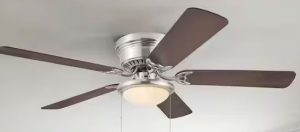
The Hampton Bay Hugger is a flush-mount ceiling fan available in 44-inch and 52-inch sizes, offered in several finishes including brushed nickel, black, pewter gunmetal, and oil-rubbed bronze. The flush-mount design makes it suitable for rooms with low ceilings where you can’t use a downrod, which is actually a legitimate selling point if you’re dealing with 8-foot ceilings or lower. The fan comes with an integrated LED light kit, reversible blades, and a three-speed motor controlled by pull chains. On paper, that sounds like everything you need in a basic ceiling fan.
The reality of what you get is considerably less impressive. The motor is underpowered and frequently produces humming, clicking, or grinding noises that range from mildly annoying to genuinely sleep-disrupting. The light kit uses a single LED bulb positioned in one direction, creating uneven illumination that leaves parts of your room noticeably darker than others. The airflow is weak due to shallow blade pitch and motor limitations, meaning the fan struggles to cool anything larger than a small bedroom. The build quality is inconsistent, with many units arriving with warped blades, loose components, or electrical issues right out of the box.
When the Hugger Might Actually Make Sense for Your Situation
Despite all these limitations, there are specific scenarios where buying a Hampton Bay Hugger could be a reasonable decision. If you’re a landlord furnishing a rental property and you need the absolute cheapest functional ceiling fan that meets code requirements, the Hugger fits that bill. Tenants might complain about the noise or weak airflow, but you’ll have fulfilled your obligation to provide a ceiling fan without spending much money. Just be prepared for potential replacement requests down the line.
If you’re outfitting a space where ceiling fan quality genuinely doesn’t matter – like a garage, workshop, storage room, or covered porch – the Hugger can provide basic air circulation at a price point that’s hard to argue with. In these applications, noise isn’t really a concern, lighting quality doesn’t matter much, and you just need blades spinning to move hot air around. The fan will accomplish that much, even if it does so noisily and inefficiently. For a temporary solution while you save up for a better fan, or for a space you’re planning to renovate soon anyway, spending $50 instead of $150 makes a certain amount of sense.
Some buyers have reported acceptable experiences with their Hugger fans, particularly in very small rooms where the weak airflow isn’t as noticeable and where the inadequate lighting can be supplemented with other fixtures. If you’re putting this in a small bedroom, closet, or hallway and your expectations are calibrated to “I just need something cheap that moves some air,” you might find the Hugger tolerable. The key word there is “tolerable” – not good, not satisfactory, just barely acceptable for minimal needs.
Why You Probably Shouldn’t Buy the Hugger
For most homeowners in most situations, the Hampton Bay Hugger is a false economy. You save $50-100 upfront compared to a decent mid-range fan, but you’ll likely end up replacing it within a few years when the noise becomes unbearable or the motor fails. When you factor in the cost of your time to install it twice, the frustration of living with a noisy inadequate fan, and the eventual replacement cost, you haven’t actually saved any money. You’ve just spread the expense out and added a lot of aggravation in the middle.
The noise issues alone disqualify this fan from bedroom use for most people. Multiple customer reviews describe constant humming, clicking with every rotation, scraping sounds, and other noises that make it impossible to sleep with the fan running. Some buyers reported trying the standard troubleshooting steps – tightening all screws, checking blade alignment, letting it “break in” for 24 hours – with no improvement. The noise isn’t coming from loose parts you can fix; it’s often coming from the motor itself or from manufacturing tolerances so poor that metal components rub against each other during operation.
The lighting situation is genuinely terrible. A single LED bulb pointing in one direction does not adequately light a room, period. You’ll have bright spots and dark corners, uneven shadows, and an overall cheap appearance that makes your room feel smaller and less inviting. Several reviewers specifically mentioned having to add supplemental lighting, which defeats much of the cost savings. If you’re going to need additional lamps or light fixtures anyway, you might as well buy a fan with a proper two-bulb or three-bulb light kit that actually illuminates the space properly.
The Quality Control Lottery You’re Playing
One of the most frustrating aspects of buying a Hampton Bay Hugger is the inconsistency. Some units work reasonably well for the price, while others are defective straight out of the box. You’re essentially playing a lottery where your odds of getting a functional fan are maybe 60-70%, based on the volume of negative reviews and complaint patterns. That means there’s a substantial chance you’ll be making a return trip to Home Depot or dealing with Hampton Bay’s notoriously unhelpful customer service to get replacement parts.
Common defects include warped or bowed fan blades that cause wobbling even with balancing kits, defective remote receivers that cause light flickering, motors that hum excessively from day one, and in some documented cases, complete electrical failures within weeks of installation. One reviewer described their brand new Hugger experiencing a motor short circuit at 4:30 in the morning that tripped their arc fault breaker with a loud pop – a potential fire hazard that’s about as serious as ceiling fan problems get. While that’s likely an outlier, the fact that it happened at all with a new product speaks to concerning quality control standards.
Industry professionals have been even more critical than regular consumers. One electrician who worked for a ceiling fan support website stated that Hampton Bay fans represented approximately 90% of all the customer complaints and problems they dealt with, compared to single-digit percentages for other major brands. His assessment was blunt: Hampton Bay products are “junk” with “almost zero quality control in their factories.” That’s a pretty damning evaluation from someone who dealt with these issues professionally on a daily basis.
Better Alternatives Worth Considering
If you’re considering the Hampton Bay Hugger primarily because of price sensitivity, I’d strongly encourage you to look at what an additional $40-80 can buy you. Hunter’s Builder series flush-mount fans typically run $90-120 and represent a massive step up in motor quality, noise levels, and reliability. These aren’t fancy fans – they’re basic and utilitarian – but they work quietly and consistently for years without developing problems. The difference between a $50 fan that drives you crazy and a $100 fan that just works reliably is absolutely worth the extra money.
Honeywell makes several low-profile ceiling fans in the $90-140 range that include remote controls, better motors, and dual-bulb light kits that actually illuminate rooms properly. The Carnegie, Glen Alden, and other Honeywell models get consistently better reviews than Hampton Bay products and have failure rates that are a fraction of what you see with the Hugger line. Spending an extra $50-90 to get a fan that doesn’t make you regret your purchase is money well spent.
Even within Hampton Bay’s own product lineup, their fans priced around $120-180 are significantly better than the Hugger. Models with downrods, better motor construction, and proper light kits get much more positive reviews and fewer complaints. The Hugger specifically seems to be where Hampton Bay cuts every possible corner to achieve that ultra-low price point. If you’re already committed to the Hampton Bay brand for some reason, at least move up to their mid-tier offerings.
What Real Owners Are Saying
Customer reviews paint a consistent picture across multiple retailers. On Home Depot’s website, the Hampton Bay Hugger ceiling fan has hundreds of reviews with common complaints appearing over and over. “Nice looking fan and easy to assemble. Unfortunately it does seem to make a scraping noise as it spins. Bought two and they both do it,” wrote one frustrated customer. Another stated simply: “It is not a quiet fan. Very noisy as it spins. It has some type of ticking noise.”
The lighting complaints are equally consistent. “Only one light and it makes my room really dark,” noted one reviewer. Another was more detailed: “We went with this fan for our baby’s nursery thinking that because it’s a small room, a $60 fixture would be just fine. You get what you pay for, and for us this was a huge waste of time. There’s only one bulb pointed in one direction, and even after trying multiple different bulbs, one side of the room is always dark.” That’s the kind of real-world feedback that should inform your purchasing decision.
Some positive reviews do exist, typically from people with very low expectations or specific use cases where the fan’s limitations don’t matter much. “Can’t beat this fan for $50. Simple to install. Super quiet,” wrote one satisfied customer, though this appears to be an outlier experience based on the overall review patterns. The fan seems to be highly inconsistent – you might get a tolerable unit, or you might get one of the many defective ones that plague this product line.
Making Your Final Decision
So should you purchase the Hampton Bay Hugger ceiling fan? In most cases, my honest answer is no. Unless you’re in one of the specific situations I outlined earlier – rental property, garage/workshop, temporary solution – you’re better off spending more for a fan that won’t frustrate you daily. The $50-100 you save upfront isn’t worth the noise pollution, inadequate lighting, weak airflow, and high probability of needing to replace the fan sooner rather than later.
If you do decide to buy a Hugger despite these warnings, at least go into it with realistic expectations and a solid return plan. Install it immediately after purchase and test it thoroughly while you’re still within Home Depot’s 90-day return window. Run it on all speeds, check for noise issues, evaluate the lighting in your actual room conditions, and assess whether the airflow meets your needs. If you notice any problems, return it immediately rather than convincing yourself you can live with it – because those problems typically get worse over time, not better.
The fundamental issue with the Hampton Bay Hugger is that it represents the absolute minimum viable product in the ceiling fan category. It technically functions as a ceiling fan, but it does so with so many compromises in quality, performance, and reliability that it rarely provides good value even at its low price point. Sometimes the cheapest option is actually the most expensive in the long run when you factor in replacement costs, wasted time, and the daily frustration of living with an inferior product.
Your home deserves better than the bare minimum, especially for something you’ll interact with multiple times every day for years. Spend the extra money on a mid-range fan from Hunter, Honeywell, or even Hampton Bay’s better product lines. You’ll thank yourself every single time you turn it on and hear silence instead of grinding noises, see your whole room illuminated instead of dark corners, and feel actual cooling airflow instead of a weak breeze. That’s worth more than any upfront savings the Hampton Bay Hugger offers.