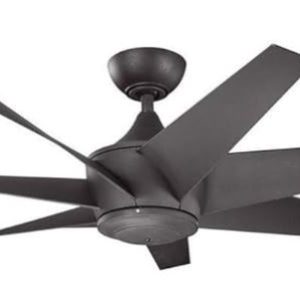
Kichler 36 inch Ceiling Fan Downrod
$66.51
Description
The Kichler 36-inch ceiling fan downrod is the component you reach for when a standard six-inch drop isn’t enough but you don’t yet need the serious length territory of a 48 or 60-inch rod. It occupies the practical middle of the downrod length range — long enough to bring a fan properly into operating position in a twelve-foot room, short enough that installation remains straightforward without the additional rigidity considerations that come with longer drops. For buyers with a Kichler fan going into a room with above-average ceiling height, it’s the most direct solution available, engineered to interface cleanly with Kichler’s own mounting systems and finished to match the brand’s extensive lineup of fan finishes.
The model designation is 360003, with the finish indicated by a suffix — 360003WH for white, 360003SBK for satin black, 360003BN for brushed nickel, and so on through the full finish range. Each finish variant is the same rod in different surface treatment, so the choice is purely about matching your fan and your room rather than any functional difference between them.
What Twelve-Foot Ceilings Actually Require
Kichler’s own guidance for the 36-inch downrod is straightforward: it’s suggested for twelve-foot ceilings. That recommendation is built on a simple formula — take your ceiling height in feet, subtract nine, and the result in inches is the approximate downrod length you need. A twelve-foot ceiling minus nine equals three feet, which is 36 inches. The formula is based on targeting blade tips at eight feet from the floor, with one foot allowed for the motor housing dimension, producing the nine-foot baseline.
It’s worth understanding what happens when you ignore that guidance in either direction. A fan installed with too short a downrod in a twelve-foot room spins close to the ceiling, where the air column it pushes has too much distance to travel before reaching the people below. The airflow is technically there but the felt cooling effect is substantially reduced, often to the point where people conclude the fan isn’t powerful enough when the real problem is positioning. A fan hung at the correct height in the same room with the same motor will feel noticeably more effective simply because the air is moving where people actually are.
The 36-inch length also works reasonably well in rooms with eleven-foot ceilings where you want the fan to hang a little further down than a 24-inch rod would allow — perhaps for aesthetic reasons, to visually anchor the fan in a taller space, or to improve airflow slightly in a room where the standard calculation puts you right at the border between two rod lengths. Downrod length decisions involve some judgment alongside the arithmetic.
The Dual-Thread Design
One detail that distinguishes Kichler’s downrod from some competitors is the dual-threaded construction — both ends of the rod are threaded rather than just the motor side. This gives installers flexibility in how the rod interfaces with both the fan’s motor coupling and the canopy assembly at the ceiling, and it means the connection is mechanically secured at both ends rather than relying on set screws or friction fit at either junction.
The practical benefit of threading at both ends shows up most clearly in installations where precise alignment matters or where the canopy-side connection needs to be adjusted during installation. A threaded connection gives you defined engagement points rather than an estimated seating depth, which simplifies getting the installation plumb and keeps it there. For a 36-inch rod — long enough that any slight misalignment at the mount becomes more visible than it would be on a short rod — having both ends positively threaded is a meaningful construction detail rather than a minor specification footnote.
The outer diameter is one inch, which is Kichler’s standard across their entire downrod lineup from 12 to 72 inches. This matters for compatibility purposes. Kichler designs their fan mounting systems around that one-inch outer diameter, and the coupling dimensions assume it throughout. Using a non-Kichler downrod with a different outer diameter in a Kichler fan creates fit issues at the coupling that can compromise both the security of the connection and the fan’s ability to hang plumb.
Finish Range and Outdoor Durability
The finish selection available for the Kichler 36-inch downrod is extensive — among the widest of any mainstream ceiling fan manufacturer. Options include Antique Pewter, Anvil Iron, Brushed Nickel, Brushed Stainless Steel, Burnished Antique Brass, Coffee Mocha, Distressed Black, Matte White, Mediterranean Walnut, Natural Brass, Oil Brushed Bronze, Oiled Bronze, Olde Bronze, Polished Nickel, Satin Black, Satin Natural Bronze, Tannery Bronze, Walnut, Weathered Copper, Weathered Steel, Weathered Zinc, and White.
That breadth reflects the reality of Kichler’s fan catalog, which spans a similarly wide range of finishes across hundreds of fan models. The whole point of offering matched downrods in every finish is that the downrod should disappear visually into the fan installation rather than reading as a separate component. A Brushed Nickel fan with a Brushed Nickel downrod and canopy looks like a single intentional fixture. The same fan with a mismatched downrod announces that a piece was added rather than matched, regardless of how close the color approximation is. Kichler’s finish matching eliminates that problem across the full range of their lineup.
For outdoor or high-humidity indoor installations, Kichler applies a powder coat finish over a galvanized under-coating on their outdoor-suitable finish variants. The galvanized base layer is the meaningful part of that specification — powder coat alone provides surface appearance and some moisture resistance, but it’s the galvanized undercoat that resists the oxidation and corrosion that eventually compromises downrods installed in covered outdoor spaces, screened porches, pool areas, and other environments where humidity and moisture exposure are ongoing rather than occasional. A downrod that corrodes at the canopy junction or develops surface rust running down from the motor housing creates both cosmetic and structural problems over time. The galvanized under-coating addresses the structural concern; the powder coat addresses the appearance.
Sizing the 36-Inch Rod Against Other Lengths
Kichler produces the same downrod design in seven standard lengths — 12, 18, 24, 36, 48, 60, and 72 inches — and understanding where the 36-inch sits in that range helps confirm whether it’s the right choice for a specific installation. The 12-inch rod handles nine-foot ceilings, 18 inches handles ten-foot ceilings, and 24 inches handles eleven-foot ceilings using the same ceiling-height-minus-nine formula. The 36-inch rod at twelve feet is a clean fit by that calculation.
At thirteen feet the formula suggests a 48-inch rod. At fourteen feet it’s a 60-inch rod. At fifteen and above you’re looking at 72 inches or, for very high ceilings, joining two rods with a Kichler coupler. The 36-inch length doesn’t stretch cleanly to cover thirteen-foot ceilings the way it covers twelve-foot rooms, so if your measurement puts you at the boundary, measuring carefully before ordering saves a return.
One practical consideration specific to 36-inch and longer downrods is blade balance. Longer drops amplify any wobble that exists in the blade assembly — a small imbalance that’s essentially imperceptible with a six-inch drop becomes a visible wobble at 36 inches. Most Kichler fans ship with a balancing kit for exactly this reason, and taking the time to balance the blades after installation on a longer rod pays dividends in smooth, quiet operation.
Compatibility and Where to Buy
Kichler’s downrods are designed for use with Kichler fans and are the recommended accessory when installing any Kichler fan that needs a longer drop than the included rod provides. They are available through Kichler’s authorized dealer network, through major home improvement retailers, and through lighting specialty retailers online. Pricing in most finish options sits in the $44 to $70 range depending on the finish variant, with some specialty finishes toward the higher end of that range.
For the buyer installing a Kichler fan in a twelve-foot room who needs to source the right downrod to complete the installation correctly, the 36-inch rod in the matching finish is a straightforward purchase that does exactly what it needs to do — bring the fan to the right height, connect cleanly to the fan’s mounting system, and hold it there reliably for as long as the fan runs.