
Hunter is the oldest ceiling fan company in the United States and one of the oldest in the world. Depending on how you count it, the company has been building fans for well over 130 years, and a significant portion of the fans it made during that run are still spinning in homes, restaurants, hotels, and historic buildings today. That kind of longevity is not an accident. Hunter built a reputation early on for motors that ran quietly, ran smoothly, and ran essentially forever with basic maintenance, and that reputation carried the brand through financial crises, world wars, the energy boom of the 1970s, and eventually into the modern era of smart fans and app-controlled ceiling fixtures. If you have a Hunter fan in your home, whether it is a cast-iron antique from mid-century or a current model you just pulled out of the box, this page covers what you need to know about the brand, the different eras of Hunter fans, their specific maintenance needs, and where to find parts and support.
Where Hunter Got Started
The company traces its origins to 1886, when John Hunter and his son James C. Hunter, Irish immigrants who had settled in upstate New York, purchased an interest in the Tuerk Water Meter Company in Syracuse. The technology of the day ran on water pressure rather than electricity, and what the Hunters developed in that first year was a belt-driven ceiling fan powered by a water motor, with two wooden blades that could move air through a room. It was a practical solution to a genuine problem in an era before air conditioning existed in any form, and word traveled fast. Within a few years Hunter was shipping fans to India, Africa, China, and across the Far East, alongside domestic sales throughout the United States.
The company moved its operations to Fulton, New York in 1889 and spent the next fifty years building its reputation there. When John Hunter died, his six sons incorporated the business and kept expanding, and by the time the electrical grid had spread broadly enough to make electric ceiling fans practical for residential use, Hunter was already positioned to lead the market. The company renamed itself Hunter Fan and Motor Company, then later Hunter Fan and Ventilating Company, as the product line grew to include desk fans, attic fans, pedestal fans, and large exhaust fans for commercial use. By the early 1920s, Hunter was widely known throughout the United States and internationally as a benchmark for quality fan manufacturing.
The Hunter Original and What Made It Different
When most people with a serious interest in ceiling fans hear the name Hunter, the first thing that comes to mind is the Hunter Original. Introduced in 1906, the Original was built around a cast-iron motor housing, real wood blades, and an oil-bath lubrication system that allowed the motor to run for decades without the kind of mechanical wear that eventually kills most electric motors. The design was heavy, solid, and deliberately over-engineered for the era, and that engineering is a significant part of why so many Originals are still in service today, more than a hundred years after they were first installed.
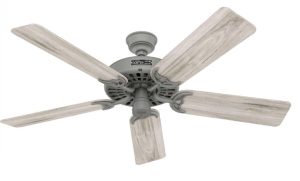
The cast-iron housing served two purposes beyond pure aesthetics. It provided the motor with a sturdy, thermally stable enclosure that dissipated heat evenly, and it gave the fan enough mass to run without vibration. Early Hunter Originals used real teak or other hardwood blades, and the motor ran on a shaded-pole motor design initially supplied by General Electric. That same basic motor design, refined over the decades, remained in production for most of the twentieth century. Hunter made incremental changes to the Original over the years, including the addition of the AdaptAir feature, which allowed the blade pitch to be changed mechanically to reverse airflow direction, useful in winter for pushing warm air that had collected near the ceiling back down into the living space. Modern fans accomplish this by reversing the motor direction electronically, but the AdaptAir mechanical pitch-change system was an innovation that predated electronic motor reversal by decades.
Antique Hunter fans, generally considered to be those made through the 1950s, are a collector category in their own right. The earliest examples can be genuinely valuable, particularly those with intact original hardware, original blades, and functioning motors. The motor designs used in these antique fans are similar to those used in the Hunter Originals that continued into the 1990s, which means that many of the maintenance practices that applied to Originals apply to the antiques as well. These fans are heavy and they are powerful, and when they are properly maintained they run with a smooth authority that modern fans rarely match.
Oiling Your Hunter Original or Antique Fan
The oil-bath lubrication system that made the Hunter Original famous is also its primary maintenance requirement. Unlike modern sealed-bearing motors that run dry and require no lubrication over their service life, the Original’s motor depends on oil to keep the bearings and motor shaft running without friction. If the oil level drops and the motor runs dry, bearing wear accelerates quickly and the fan becomes noisy, wobbles, or eventually seizes. This is the most common way that Hunter Originals fail, and it is entirely preventable with a simple oiling routine.
Most Hunter Originals and antique Hunter fans have an oil reservoir built into the top of the motor housing, accessible through a small fill hole or port. The type of oil matters. Hunter specifies non-detergent electric motor oil for these fans, typically a 10-weight or 20-weight. Regular household machine oil, 3-in-One oil, and especially automotive engine oil are not correct for this application and can damage the motor over time. Non-detergent motor oil is available at hardware stores and online, and it is worth keeping a small bottle on hand if you own one of these fans. The fill interval depends on how much the fan runs, but checking the oil level once a year and topping it off is a reasonable standard practice for a fan that runs regularly through the cooling season. Filling slowly and not overfilling is important, as oil that gets into the motor windings from an overfill can cause problems of its own.
A Hunter Original or antique fan that has been sitting unused for years, or one that has been running dry, may show signs of stiffness when you first try to spin the blades by hand. In many cases, adding fresh oil and letting the fan sit for a day or two while the oil works its way through the bearings will restore smooth operation. Running the fan on its lowest speed setting for the first few hours after a long dormancy period is a gentler way to bring it back up to operating condition than running it at full speed immediately.
The Flywheel Issue on Early Imported Models
In the early 1980s, Hunter introduced its first line of imported fans, sold under the Robbins and Myers label. These fans used a fundamentally different motor design than the traditional American-made Hunters, and they incorporated a rubber flywheel as part of the drive mechanism. The rubber flywheel was meant to absorb vibration and help keep the fan running smoothly, but rubber degrades over time, particularly when exposed to heat, and the flywheels in these fans eventually crack, harden, or break apart. When the flywheel fails, the fan typically wobbles severely, makes noise, or stops spinning the blades altogether even though the motor itself is still running.
The good news is that flywheel replacement is a well-documented repair for these fans. Replacement rubber flywheels are available through ceiling fan parts suppliers and online, and the swap is manageable for someone comfortable with basic mechanical work. The fan needs to come down from the ceiling, the motor housing needs to be opened, and the old flywheel needs to be pulled from the motor shaft and replaced with a new one of the correct size and durometer. There are guides and videos available online that walk through the process for the specific Robbins and Myers motor variants, and matching the correct flywheel to the motor requires either knowing the motor model number from the housing or measuring the old flywheel’s dimensions carefully before ordering a replacement.
Beyond the flywheel, the early imported Hunter fans from this era do not have a pattern of recurring mechanical failures. The motors in these fans are generally solid, and once the flywheel issue is addressed, fans that were running poorly often return to smooth, quiet operation. If you have one of these fans that is wobbling or making noise, the flywheel is the first thing to check before assuming the motor itself has failed.
How Hunter Fans Evolved Through the 1980s and 1990s
The oil embargo of 1973 and the resulting energy crisis changed the ceiling fan market dramatically. When electricity costs rose and central air conditioning became expensive to run, ceiling fans went from a niche product to a mainstream home comfort item almost overnight. Hunter was well positioned to benefit from that shift, but it also meant significantly higher production volumes and a more competitive market than the company had operated in for most of its history. Through the 1980s, Hunter expanded its product line considerably, moving into more decorative styles, introducing remote controls, adding light kit options, and designing fans specifically for outdoor and kitchen use.
By the late 1980s and into the 1990s, Hunter had become the first ceiling fan manufacturer to define the ceiling fan as a primary light source, adapting halogen light kits to its fan units and marketing the combination aggressively. The company also launched one of the largest advertising campaigns in the history of the fan industry during the early 1990s, running television spots and full-color magazine spreads in major national publications. Through this period, Hunter acquired several complementary businesses including Ronel, a decorative lighting fixture manufacturer, and expanded into air conditioners, dehumidifiers, and programmable thermostats. The company continued to emphasize quality and warranty coverage throughout this era, establishing its limited lifetime motor warranty as a benchmark that competitors measured themselves against.
What Hunter Makes Today
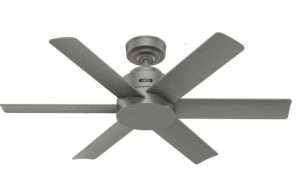
The modern Hunter lineup is broad enough to cover nearly any residential ceiling fan application. At the traditional end, the Hunter Original remains in production in updated forms, including the 1886 Limited Edition, which uses a sand-cast motor housing and carved wood blades in a deliberate nod to the company’s Victorian-era roots, paired with the WhisperWind motor that Hunter uses across much of its current lineup. The WhisperWind motor is Hunter’s proprietary design, built with heavy-gauge copper windings, precision ball bearings, and high-grade silicon steel, and engineered to run without the noise and wobble that plagued lower-quality fans of previous eras.
Hunter’s SureSpeed guarantee, introduced in 2019, promises that fans carrying the designation will move air at meaningfully higher velocity than leading competitors at the same blade span. The WeatherMax outdoor line, introduced in 2020, steps beyond the standard wet-rated certification that most outdoor ceiling fans carry and is specifically rated for salt air and coastal environments where corrosion is a constant factor. For homeowners who want smart home integration, Hunter’s HunterSMART platform supports Wi-Fi connectivity and app control without requiring a separate smart hub, which has become an increasingly common requirement in a market full of fans that work with Alexa or Google Home in theory but require an additional bridge device in practice.
The HunterExpress line, launched in 2022, takes a different approach to the installation problem, reducing the process to three steps with a mounting system designed to get a fan from box to ceiling faster than any previous Hunter product. For buyers who find ceiling fan installation intimidating, the simplified mounting system is a genuine selling point. Hunter also launched a full lighting product line in 2022 under the Hunter Lighting name, adding chandeliers, pendants, wall sconces, flush mounts, and bathroom vanity lights to the brand portfolio for the first time in any significant way.
Hunter’s Warranty and What It Covers
Hunter backs its fans with a limited lifetime motor warranty, which is one of the strongest warranty commitments in the residential ceiling fan category. The warranty covers the motor against defects in materials and workmanship for the life of the original purchaser, which in practical terms means that a Hunter motor that fails under normal residential use conditions is covered for replacement regardless of how long ago the fan was purchased. This warranty applies to the motor specifically, not to blades, light kits, remotes, or cosmetic components, which carry their own shorter warranty terms depending on the specific product.
Claiming warranty service requires proof of purchase, so keeping the receipt or order confirmation for a Hunter fan is worth doing from the start. Hunter’s customer service handles warranty claims and can advise on whether a specific issue falls within warranty coverage. The company’s warranty reputation has been part of its market positioning for decades, and it remains one of the reasons that buyers willing to spend more than the minimum on a ceiling fan often choose Hunter over competing brands at similar price points.
Finding Parts and Remote Controls for Your Hunter Fan
Hunter produces a wide range of replacement parts and accessories for its current and recent fan lineup, including replacement blades, blade arms, glass globes, light kits, and remote control systems. The Hunter website sells parts directly, and many current-model parts are also available through Home Depot and other retail channels. For older models, the parts picture is more varied. Current-production parts from Hunter are sized and designed for current-production fans, and compatibility with older models depends on whether the specific component dimensions and mounting configurations match.
Remote controls for Hunter fans use radio frequency rather than infrared, which means the remote does not require line-of-sight to the receiver and works through walls and from other rooms. Hunter’s current remotes are sold with a receiver that installs in the fan’s canopy and intercepts the wall switch wiring, and the system works with most Hunter fans that do not already have a built-in receiver. For fans that are more than a decade old, compatibility should be confirmed before purchasing a replacement remote, as receiver pinout and frequency specifications have changed across product generations. Hunter’s customer service line can confirm compatibility by model number, which is typically printed on a label inside the motor housing or on the canopy.
For antique Hunter fans and Hunter Originals, parts sourcing is a different conversation. The collector community around vintage Hunter fans is active enough that parts, restoration services, and model-specific knowledge are available through specialty suppliers, online forums dedicated to ceiling fan restoration, and periodic estate sales and auctions where complete fans or parts come up for individual sale. If you have a vintage Hunter and you are looking for a specific component, reaching out to the vintage fan community is often more productive than contacting Hunter directly, since the company’s current parts inventory does not extend back to pre-war or mid-century production.