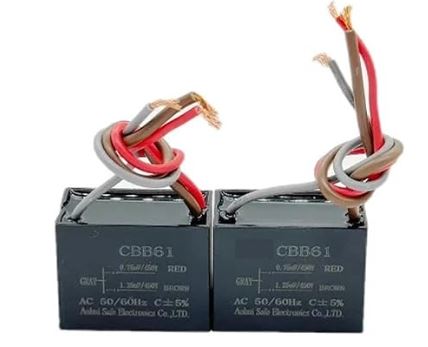
5PCS Ceiling Fan Light Starting Capacitor CBB61 0.75UF+1.25UF 450V Three Wire
$100.00
Description
The capacitor is the most overlooked component in a ceiling fan, right up until it fails. When it does, the symptoms are hard to miss — the fan hums on the shelf of starting but never actually spins, or it runs sluggishly on every speed setting, or it refuses to drop below high regardless of what the pull chain says. In most cases, the motor itself is perfectly fine. The capacitor is a three-dollar part that’s been quietly degrading for years, and replacing it brings an otherwise dead fan back to full function in under twenty minutes. This CBB61 three-wire unit in the 0.75µF + 1.25µF 450V configuration is exactly the kind of no-frills replacement part that does that job reliably, and at the price point of a five-pack, it makes keeping a spare on hand an easy decision.
To understand what this capacitor actually does and why the specifications matter, it helps to know a little about how ceiling fan motors work. A standard ceiling fan uses a permanent split capacitor motor — a single-phase AC motor with two windings, a main run winding and an auxiliary winding. The capacitor sits in series with the auxiliary winding and creates a phase shift in the current flowing through it, which generates the rotating magnetic field that causes the rotor to turn. Without the capacitor, the motor can receive full voltage and still produce nothing more than a hum, because the current in both windings is in phase and no rotating field is produced. The capacitor is what converts a stationary buzzing motor into a functioning one, and it’s also what allows different fan speeds to exist — by switching in different capacitance values across different speed settings, the speed control circuit changes the phase relationship and the resulting torque, which is why this particular unit carries two capacitance values in a single housing.
The three-wire configuration of this CBB61 tells you everything about how it’s wired into the speed circuit. There are three leads: a common wire, typically red, and two output wires — one carrying the 0.75µF section and one carrying the 1.25µF section. In a standard three-speed pull chain fan, the speed switch routes power through different combinations of these capacitor sections to produce high, medium, and low speed. High speed often bypasses the capacitor entirely, running the motor at its maximum torque with no phase-shifted load. Medium routes through one section, and low through the other or through both in series, reducing torque and therefore speed at each step. Understanding this wiring logic matters when you’re installing a replacement, because connecting the wrong wire to the wrong terminal in the speed switch will give you incorrect speeds or no speed change at all.
The 450V rating on this capacitor deserves specific attention because it’s one of the specifications most people glance past without considering its significance. North American residential circuits run at 120V, so a capacitor rated for 450V might seem like overkill. It isn’t. The voltage rating on a capacitor represents the maximum voltage the dielectric can withstand without breaking down, and in a motor circuit the voltage across the capacitor can spike well above the supply voltage due to back-EMF — the voltage generated by the spinning motor windings acting as a generator. Running a capacitor rated below its actual operating voltage leads to dielectric breakdown, premature failure, and in worst cases a capacitor that vents or ruptures internally. The 450V rating here provides comfortable headroom above real-world operating conditions, which is a meaningful quality indicator for a component you’re going to install inside a motor housing and forget about.
The 0.75µF + 1.25µF capacitance values place this unit in the range used by lighter-duty ceiling fans, particularly smaller diameter models in the 42-inch to 52-inch range and older fans that used lower-torque motor designs. This is not a universal replacement for every ceiling fan on the market — larger fans, particularly 52-inch and 60-inch models with higher-torque motors, more commonly require capacitance values in the 2µF to 6µF range, sometimes in four-wire or five-wire configurations. Before ordering, you need to pull the existing capacitor out of your fan’s motor housing and read the µF values printed on its casing. If they match 0.75 and 1.25, this unit is a direct replacement. If they don’t, this is the wrong part regardless of how well everything else matches. Capacitance value is non-negotiable — running a motor with the wrong µF rating causes speed miscalibration, increased current draw, and long-term motor damage.
The polypropylene film construction is the right material choice for a motor run capacitor in this application. Unlike electrolytic capacitors, which are polarized and degrade through chemical processes over time, polypropylene film capacitors are non-polarized, handle AC voltage natively, have very low equivalent series resistance, and maintain their capacitance value with minimal drift over years of continuous operation. The self-healing property of metallized polypropylene film — where minor dielectric breakdowns cause the thin metal film to vaporize locally rather than creating a permanent short — gives these capacitors a resilience that older paper film designs simply can’t match. For a component that runs continuously whenever your fan is on, potentially for twelve or more hours a day in a bedroom or living room, longevity under sustained operation matters more than peak performance metrics.
The five-pack format is one of the practical selling points of this listing, and it’s worth thinking about how that changes the value proposition compared to buying a single unit. At the price per unit in a five-pack, you’re paying roughly what a single capacitor costs from a local hardware store — if your hardware store even stocks this configuration, which many don’t. Having four spares means you can replace the capacitor in every ceiling fan in your home at the first sign of trouble rather than waiting for a complete failure, you have extras for fans you haven’t diagnosed yet, and you’re covered for the inevitable situation where one replacement doesn’t quite solve the problem and you need to revisit. For anyone who does their own home repair, owns multiple ceiling fans, or manages rental properties, buying in multiples at this price is simply the sensible approach.
Installation is straightforward for anyone comfortable shutting off the breaker and handling basic wiring inside a motor housing. Cut power at the breaker — not just the wall switch — before opening the fan. Drop the lower housing cover to access the motor’s internal wiring, locate the existing capacitor, photograph the existing wire connections before disconnecting anything, remove the old unit, and connect the new one in the same configuration. The wire colors on the replacement should match the conventions of the original — red to common, yellow to the 0.75µF output, blue to the 1.25µF output — but always verify against your fan’s wiring diagram rather than relying on color conventions alone, since not all manufacturers follow the same scheme. Secure the connections with wire nuts, tuck the capacitor back into the housing, restore power, and test all three speeds before closing everything up.
At the price point this five-pack represents, the CBB61 0.75µF + 1.25µF 450V is a solid, competent replacement capacitor for the specific fans it fits. It won’t suit every ceiling fan motor — you need to match your µF values exactly — but for lighter-duty three-speed fans that use this configuration, it’s a dependable fix for the most common cause of ceiling fan failure. The 450V rating is appropriate, the polypropylene film construction is correct for the application, and the five-pack pricing makes it genuinely economical for anyone who maintains more than one fan. If your fan is humming but not spinning, sluggish on all speeds, or stuck on a single speed, this is the first thing to replace before you write the motor off entirely.