
Halsey has been making quality imported fans for different companies for many years. Fans that were made by Halsey at one time include Gulf Coast, Homestead, Regency, Hampton Bay, Casablanca, Key Largo, Modern Fan/Beverly Hills, and Sonica. It is also possible to find fans actually marketed under the Halsey name. Some Halsey-made fans will have rubber flywheels that require replacing. Others will have electronics, such as remote and wall controls, that may go bad. In these cases there are no known easy repairs. For their more basic fans, the most common issues will be capacitors and pullchains needing replacement. As with all older fans, with age and use the bearings may become dry or dirty and require oiling or replacement, see oiling section.
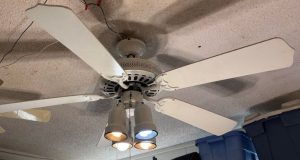
What Halsey Actually Does
Halsey Taylor Corporation has been in the ceiling fan manufacturing business for decades, but they’ve mostly operated behind the scenes. Instead of selling fans under their own name, they’ve manufactured fans for some pretty big players in the industry. We’re talking Gulf Coast, Homestead, Regency, Hampton Bay, Casablanca, Key Largo, Modern Fan Company, Beverly Hills Fan Company, and Sonica. That’s a pretty impressive client list.
You might occasionally stumble across a fan that actually says “Halsey” on it somewhere, but those are relatively rare. Most of the time, the Halsey connection only becomes obvious when you start taking the fan apart and looking at internal components. The motor housing, the mounting bracket, or sometimes a small stamp on the flywheel – that’s where you’ll find evidence of Halsey’s handiwork.
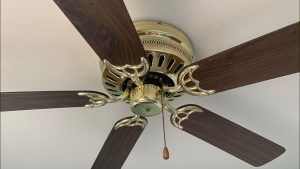
The Good and the Not-So-Good About Halsey-Made Fans
Here’s where things get a bit mixed. Halsey manufactured fans across a pretty wide quality spectrum, depending on what the client company wanted and what they were willing to pay for. Some of the fans they built are genuinely well-made, solid performers that can run for decades with minimal fuss. Others, particularly the budget-oriented models, had some design quirks that tend to cause problems down the road.
The rubber flywheel issue is probably the most notorious. A bunch of Halsey-manufactured fans from certain years used rubber flywheels instead of the more traditional metal ones. Rubber seemed like a good idea at the time – it was quieter and absorbed vibration nicely. Problem is, rubber deteriorates. After 10 or 15 years, those rubber flywheels start to crack, crumble, and eventually just fall apart. When that happens, your fan is basically done unless you can track down a replacement flywheel, which isn’t always easy since many of these models are discontinued.
On the electronics side, some Halsey fans came with integrated remote receivers or wall control systems. When these work, they’re convenient. When they don’t – and eventually they don’t – you’re looking at a headache. The proprietary electronics in some of these fans aren’t well-documented, replacement parts are scarce, and there’s no real standard repair procedure. Sometimes the remote receiver is buried inside the motor housing in a spot that’s nearly impossible to access without completely disassembling the fan.
The Stuff That Actually Breaks (And What You Can Do About It)
If you’ve got a simpler Halsey-manufactured fan – one without all the fancy electronics – the repair situation is a lot more manageable. The two most common problems you’ll run into are dead capacitors and broken pull chains.
Capacitors are what give your fan motor the boost it needs to get spinning and to switch between speeds. They’re basically energy storage devices, and they wear out over time. If your fan won’t start, or it starts but only runs on one speed, or it runs slower than it used to, there’s a good chance the capacitor is toast. The good news is capacitors are cheap – usually under ten bucks – and they’re not too hard to replace if you’re comfortable working with electrical components. You’ll need to turn off the power at the breaker, pop open the motor housing, disconnect the old capacitor, and wire in the new one. Just make sure you get a capacitor with the right microfarad (μF) rating for your specific fan motor.
Pull chains break for the obvious reason – people yank on them for years. Eventually the little chain itself snaps, or the internal switch mechanism inside the pull chain assembly wears out. Replacing a pull chain switch is a bit more involved than swapping a capacitor, but it’s still doable for someone with basic DIY skills. You’ll need to remove the fan from the ceiling (or at least the motor housing from the mounting bracket), take apart the switch housing, and install a new switch assembly. The tricky part is making sure you get the right replacement switch, since there are different configurations for different fan models.
When Bearings Go Bad
This applies to pretty much any ceiling fan that’s been running for 20+ years, but it’s worth mentioning here. The bearings that support the motor shaft can dry out or get gummed up with dust and debris over time. When that happens, you’ll hear it – grinding noises, squeaking, or just general roughness when the fan runs. Sometimes the fan will still spin but it’ll wobble like crazy.
For many older Halsey fans, the bearings are permanently sealed, which means you can’t really oil them. The fan was designed to run for its expected lifespan and then get replaced. But if you’ve got a fan with accessible bearings – usually indicated by little oil ports on the motor housing – you can extend its life significantly by adding a few drops of electric motor oil every few years. Not WD-40, not 3-in-One oil, but actual electric motor oil or a lightweight machine oil. Just a few drops in each oil port, let it work its way into the bearings, and you’re good for another few years.
If the bearings are shot and can’t be oiled, you’re looking at either a motor replacement (which usually isn’t cost-effective on an older fan) or just replacing the whole fan. At that point it becomes an economic decision – if it’s a fan you really like and it has sentimental value, maybe it’s worth the hassle of finding replacement parts. If it’s just a generic builder-grade fan, your time and money are probably better spent on a new one.
Finding Parts for Halsey Fans
This is where things get frustrating. Because Halsey manufactured for so many different brands, there’s no single source for replacement parts. The part you need depends entirely on which brand’s fan you actually have. If it’s a Hampton Bay model, you might find parts through Home Depot’s parts department or through third-party suppliers. If it’s a Casablanca, you might have better luck since Casablanca has a stronger parts network. But if it’s a discontinued Homestead or Regency model, you’re probably going to be searching eBay, salvage yards, or ceiling fan repair forums.
The motor assemblies are particularly tough to source. Because each brand had slightly different specifications, a motor from one Halsey-manufactured fan won’t necessarily work in another, even if they look similar. The mounting brackets might be different, the electrical connections might not match up, or the physical dimensions might be just different enough to cause problems.
Pull chain switches and capacitors are usually more generic, so those are easier to find as long as you know the specifications you need. Just bring the old part with you to an electrical supply store or search online with the specific ratings printed on the component.
How to Tell if Your Fan Was Made by Halsey
Unless there’s an actual Halsey label somewhere on the fan, you’re usually looking for clues. The motor housing is the most likely place to find manufacturer markings. Sometimes there’s a small metal tag with company information, manufacturing dates, or a model number that can be cross-referenced. On some fans, you’ll find “Made in Taiwan” or “Made in China” stamps along with cryptic model codes that, with enough internet searching, can be traced back to Halsey manufacturing runs.
The mounting bracket and downrod connection point sometimes have Halsey part numbers stamped on them. If you’ve got a fan with the problematic rubber flywheel, that’s a pretty strong indicator it came from Halsey, since they were one of the main manufacturers using that design during a certain period.
Really, the best way to confirm Halsey manufacturing is to search for your specific fan model online and see what information comes up in ceiling fan enthusiast forums. There are some dedicated folks out there who’ve documented the manufacturing history of tons of fan models, and they can usually tell you who actually built a particular fan based on photos of the internal components.
Are Halsey Fans Worth Repairing?
Depends on what’s wrong with it and what the fan means to you. If it’s a simple fix – replacing a capacitor or a pull chain – yeah, absolutely worth doing. Those repairs cost maybe $20-30 in parts and an hour of your time. Even if you have to pay someone to do it, you’re looking at maybe $100-150, which is less than buying and installing a new fan.
If the motor’s shot, the bearings are destroyed, or you’ve got a failed electronic control system that can’t be easily replaced, the math gets trickier. A new motor assembly, if you can even find one that fits, might run you $75-150. Add in the hassle factor of sourcing the right part and doing the installation, and you’re approaching the cost of a new fan. At that point, unless you’ve got a particularly nice fan or one you’re attached to for sentimental reasons, replacement usually makes more sense than repair.
The rubber flywheel problem is kind of in the middle. If you can find a replacement flywheel (some aftermarket suppliers carry them), it’s a worthwhile repair on an otherwise solid fan. But if the flywheel is completely disintegrated and you can’t source a replacement, you’re done. The fan becomes a parts donor at best.
What Halsey Fans Tell Us About the Industry
The whole Halsey story is actually pretty revealing about how the ceiling fan industry works. A lot of the brands consumers recognize and trust don’t actually manufacture their own products. They design them, spec them out, manage quality control, and handle marketing and distribution, but the actual manufacturing happens overseas at facilities like Halsey’s. This isn’t necessarily a bad thing – some contracted manufacturers do excellent work – but it does mean that “brand loyalty” in ceiling fans is sometimes more about marketing and parts support than about fundamentally different manufacturing quality.
Two fans from completely different brands might roll off the same Halsey production line, just with different paint jobs and motor speeds. The real differences come down to what specs each brand ordered, what quality level they were willing to pay for, and how well they support their products after the sale.
If you’ve got a Halsey-manufactured ceiling fan, what you’ve really got is a fan made for whatever brand is stamped on it. Whether that’s a good thing or a frustrating thing depends on which brand it is, how old the fan is, and what kind of shape it’s in. The simpler the fan, the better your chances of keeping it running with basic maintenance and occasional repairs. The more electronic complexity and proprietary components it has, the more likely you’ll eventually hit a point where repair becomes impractical.
The key is being realistic about repair costs versus replacement costs, and knowing when to call it quits on a fan that’s cost more in time and frustration than it’s worth.