
Lasko Products has been an American company since 1906, founded by Henry Lasko and headquartered in West Chester, Pennsylvania. For several decades during the latter half of the 20th century, Lasko manufactured and imported ceiling fans sold primarily through mass-market retailers including Walmart and Sears. They occupied a practical, affordable tier of the market — not premium fans, but genuinely decent quality for the price, particularly the American-made models. Lasko no longer produces ceiling fans, but a significant number of their fans are still running in homes today, and people with working Lasko ceiling fans are often looking for maintenance guidance, parts help, or an honest assessment of whether it’s worth keeping an older unit going. This page covers both the history of Lasko’s ceiling fan lineup and the practical information you need if you have one.
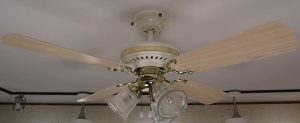
American-Made vs. Imported Lasko Fans: What the Difference Means
Lasko produced two distinct categories of ceiling fans — American-manufactured models and imported models — and they differ enough in construction that troubleshooting and maintenance approaches aren’t identical between them. The American-made Lasko fans used all-metal motor housings, which contributes to their durability and longevity. These fans were built more solidly than the imported counterparts and have generally held up better over the decades. Some of Lasko’s earliest ceiling fan offerings in the 1980s were manufactured in Japan, with later domestic production shifting to their own US facilities. The American models varied in speed control design — most were three-speed, some were four-speed, and a subset used infinitely variable speed controls operated by a potentiometer and transistor system rather than a simple switched capacitor arrangement.
The imported models used porcelain and/or plastic motor housings rather than all-metal construction. They’re more lightweight and less robust than the American-made fans, but many are still running reliably if they’ve been reasonably maintained. The imported fans also used cloth pull cords rather than the plastic pull chains common on domestic models. Cloth pull cords have a tendency to fray with age or pull out of the cord connector if worn through — the repair is straightforward, since a new cord can simply be tied back on to the existing connector, but it requires getting the fan down and working on the pull chain assembly. If your Lasko has cloth cords and they’re showing wear, replacing them before they fail completely is easier than dealing with a disconnected cord that’s dropped inside the motor housing.
The Variable Speed Control Problem
Some American-made Lasko ceiling fans were sold with a variable speed wall control that used a potentiometer — a rotary resistance dial — in combination with a transistor to provide infinitely variable speed rather than discrete low/medium/high settings. This was a more sophisticated control system than most fans at the price point offered, and when it worked it was genuinely convenient. The failure mode, however, is a known issue: the transistor in the circuit can short, and when it does the fan loses variable speed control and will only operate at full speed regardless of the dial position. There is no simple in-place repair for a shorted transistor — the component itself is a small electronic part that would need to be desoldered and replaced, which requires electronic repair skills and is impractical for most homeowners. In most cases when this failure occurs, the practical options are to bypass the variable speed control entirely and wire the fan to a standard wall switch (which gives you on/off only), replace the control system with a modern compatible speed control if the fan’s motor characteristics allow it, or accept that the fan only runs on high. Running a fan continuously on high is harder on the motor than variable operation, so if you’re planning to keep the fan long-term it’s worth addressing the control situation rather than leaving it stuck on high indefinitely.
Noisy Bearings: Why Lasko Fans Are Prone and What to Do
Lasko ceiling fans have a well-documented tendency toward bearing noise over time — more so than many other brands from the same era. The most common symptoms are humming, grinding, or a rhythmic ticking that increases with fan speed. The cause is typically dry or contaminated bearings in the motor. Most ceiling fan motors of this era use sleeve bearings or ball bearings that were lubricated at the factory, and over years of use that lubrication either dries out or becomes contaminated with dust and debris pulled through the motor by airflow. Lasko fans seem to reach this point faster than comparable fans from Hunter or Emerson from the same period, which may be related to bearing clearances in the motor design or the grade of lubricant originally used.
The good news is that bearing noise in a Lasko ceiling fan is often fixable with oiling, particularly on American-made all-metal motor models that have accessible oil ports. The correct lubricant is lightweight non-detergent machine oil — 10, 15, or 20 weight. Non-detergent is essential: oil with detergent additives can foam or break down inside the bearing housing and accelerate wear rather than reduce it. Never use WD-40 in a ceiling fan motor. WD-40 is a water displacer and penetrant, not a long-term lubricant, and it will evaporate and leave behind residue that can gum up bearings and make noise worse. On models with accessible oil ports on the motor housing top, a few drops of the correct oil into the port and running the fan at low speed to distribute it will often quiet the motor significantly within a few minutes of operation. On models without accessible oil ports, reaching the bearings requires partial motor disassembly — this is more involved but still within range of a careful DIYer with basic tools and a clean workspace.
If oiling doesn’t resolve the noise or the fan has been running dry long enough that the bearings have worn significantly, the bearing noise may be a sign of advancing motor failure rather than just dry lubrication. A fan that has developed a loud grinding or metallic scraping noise, runs noticeably slower than it used to, or runs warm to the touch at the motor housing is showing signs of motor wear beyond what lubrication will fix. At that point, the practical decision is whether the fan is worth the effort of motor repair or replacement versus replacing the fan entirely.
Parts Availability for Lasko Ceiling Fans
Lasko no longer manufactures ceiling fans, which means genuine OEM replacement parts are not available through any official channel. For practical purposes this means parts sourcing requires either finding compatible aftermarket components by spec or tracking down salvaged original parts. Blades for Lasko fans can often be matched by measuring the blade length, the blade bracket hole spacing, and the blade pitch angle — standard ceiling fan blade suppliers carry replacement sets in common sizes that may fit without modification. Capacitors, which are a common failure point on older fans, can be matched by electrical spec (microfarad rating and voltage rating) rather than by part number, since a capacitor is a generic electrical component. The capacitor spec is typically printed on the existing capacitor body and is readable with a flashlight and a phone camera in most cases.
The pull chain switches used on Lasko fans are also generally replaceable with generic ceiling fan pull chain switches, which are widely available and inexpensive — the replacement requires matching the number of speeds (the switch positions) to the original and connecting the wires correctly per a wiring diagram. For the cloth pull cords on imported models, replacement cord is available at hardware stores and the repair involves tying on new cord to the existing toggle connector.
Lasko, Air King, and What Happened to the Ceiling Fan Line
Lasko exited the ceiling fan market at some point after their domestic manufacturing period, shifting their product focus to the portable fan, heater, and air purifier categories where they remain active today. Air King, which is sometimes referenced in connection with Lasko’s ceiling fan history, is actually a Lasko subsidiary rather than a separate company — Lasko acquired Air King to expand into commercial ventilation products including range hoods, exhaust fans, and bath fans. Air King did produce ceiling fans as imported products in standard residential sizes (42-inch and 52-inch, in brass and white finishes), but this was an Air King product line rather than a continuation of Lasko’s ceiling fan manufacturing. If you have a ceiling fan labeled Air King, it is an imported product with no connection to Lasko’s American-made ceiling fan heritage other than corporate ownership.
Lasko continues to operate today as a major US manufacturer of portable fans and heaters, with manufacturing and assembly facilities in Tennessee, Texas, and Pennsylvania. They have no current ceiling fan products under any brand. For support on current Lasko portable fans or heaters, their customer service is active — but for ceiling fan support, the product line has been discontinued long enough that the company itself is not a useful resource.
Is a Lasko Ceiling Fan Worth Keeping?
The American-made all-metal Lasko fans are genuinely worth maintaining if they’re in reasonable condition. The motor construction is solid enough that with proper oiling and attention to the bearing condition, these fans can continue running reliably for many more years. The blade and control issues that come up are mostly fixable with generic parts and some patience. The imported models are a more situational judgment — if the motor is quiet and the fan is balanced, there’s no reason to replace it, but if the motor is noisy and oiling hasn’t helped, the repair investment for an imported fan may not be justified compared to a new mid-range fan with a warranty and readily available parts support. The variable speed transistor failure on American models is the one scenario where the cost-benefit math genuinely depends on how much you value the variable speed feature — if you’re content with on/off operation, bypassing the failed control system costs almost nothing; if you want variable speed back, it’s a more involved repair on aging hardware.